



The Classic Story of the Moon
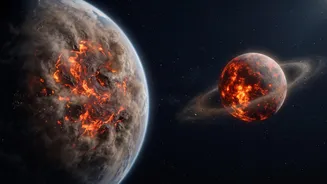
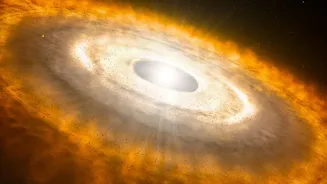
For a long time, the most widely accepted explanation for the Moon's existence has been the "giant-impact hypothesis". This theory suggests that about 4.5 billion years ago, the early solar system was a chaotic place. During this time, a protoplanet roughly
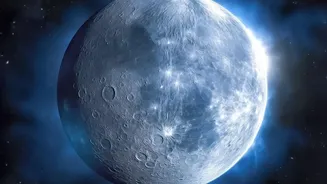
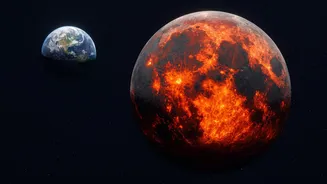
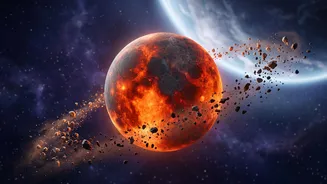
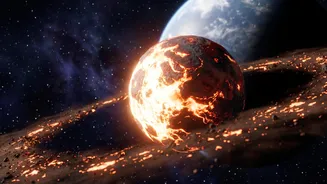
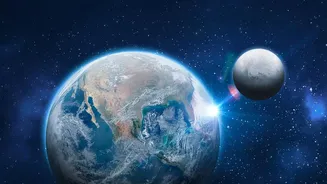
the size of Mars, nicknamed Theia, slammed into a young, still-forming Earth. The colossal collision would have ejected a massive amount of molten rock and debris into orbit around our planet. Over a long period—perhaps months or years—this debris is thought to have slowly clumped together, or accreted, under its own gravity to form the Moon we see today. This theory successfully explained several key features, such as the Moon's relatively small iron core and why it was once molten.
A New, Faster Possibility
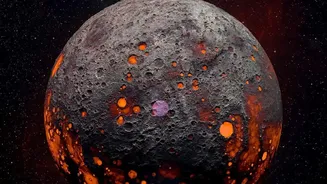
Recent supercomputer simulations are challenging that slow-and-steady narrative. Research led by scientists at NASA's Ames Research Center and Durham University suggests the Moon could have formed in a matter of hours, not millennia. By running incredibly high-resolution simulations, some of the most detailed ever conducted for this purpose, scientists found a different potential outcome. Instead of creating a disk of debris that slowly formed the Moon, the impact could have immediately launched a large, intact body—a proto-Moon—directly into a stable orbit. In one stunning simulation, a Moon-sized satellite emerged just five hours after the initial collision.
Why Do We Need a New Theory?
The classic giant-impact model isn't perfect. One of its biggest challenges is explaining a crucial fact discovered from the Apollo missions: rocks from the Moon are strikingly similar in chemical composition to rocks from Earth's mantle. If the Moon formed mostly from the debris of Theia, as earlier models suggested, its composition should be different from Earth's. The new, rapid-formation scenario provides a potential solution. In these immediate-launch simulations, the Moon forms from a larger chunk of material from Earth's outer layers, which would naturally explain the chemical similarities that have long puzzled scientists. This offers a cleaner explanation that aligns better with the evidence we have from lunar samples.
From Simulation to Proof
It is crucial to remember that this five-hour formation is a possibility demonstrated in a computer model, not yet a proven fact. The outcome of the simulations depends heavily on the initial conditions, such as the temperature, spin, and angle of impact of the colliding bodies. Researchers found that the internal temperature of the early planets was a key, previously understudied factor. A hotter, weaker proto-Earth and Theia were more likely to produce the rapid-formation scenario. To confirm this theory, scientists will need more data. Future missions that return samples from deep within the Moon's mantle could provide the physical evidence needed to determine whether our cosmic neighbour was born in a flash of cosmic violence or assembled slowly over time.
What It Means in Practice
So, what does this actually change? For one, it could reshape our understanding of how planets and their satellites form throughout the universe. If moons can form this quickly, then the debris disks we search for around distant exoplanets might be incredibly short-lived and harder to find. This new theory also helps refine the timeline of the early solar system. Linking the formation method to the temperature of the proto-planets could help scientists better constrain exactly when the giant impact occurred. Ultimately, this research is a powerful reminder that our understanding of the cosmos is constantly evolving. A question that seemed settled can be reopened by new technology and fresh perspectives, pushing us to keep exploring the history of our own planetary backyard.