



A Cosmic Fugitive
In the vast, ordered dance of the cosmos, there are rules. One of the most fundamental is that supermassive black holes, objects with millions or billions of times the mass of our sun, anchor the centers of large galaxies. But a recent discovery has revealed
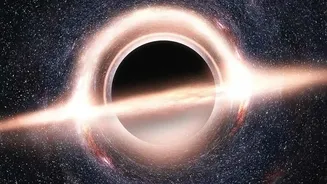
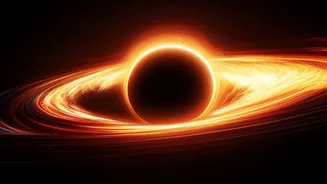
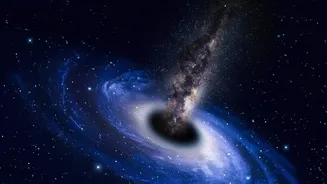
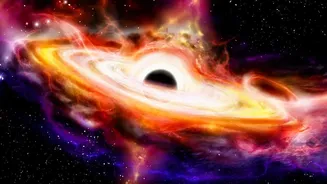
a stunning exception. Astronomers have found a dormant, supermassive black hole wandering about 30,000 light-years from the center of its host galaxy. Until now, every confirmed supermassive black hole was found nestled in a galactic core. This discovery proves that these cosmic giants can, and do, roam the galactic suburbs, lurking where we least expect them. The black hole itself is invisible, but it gave away its position in the most dramatic way possible: by shredding a passing star.
An Accidental Discovery
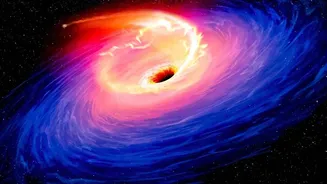
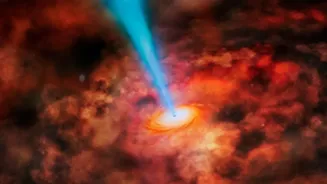
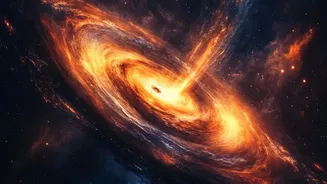
Because they don't emit light, dormant black holes are nearly impossible to find. This one was discovered only because of a brief, brilliant flare caused by a 'tidal disruption event,' or TDE. A TDE happens when a star strays too close and the black hole’s immense gravity tears it apart. As the stellar debris swirls around the black hole, it heats up and creates a flash of light so intense it can be seen across the universe. At its peak, this particular flare radiated with the brightness of 10 billion suns. The flare was first spotted by the Zwicky Transient Facility, whose AI algorithm flagged it as unusual because it didn't come from a galaxy's center. Follow-up observations from NASA’s Neil Gehrels Swift Observatory, which can detect ultraviolet and X-ray light, confirmed the nature of the event and helped pinpoint the wandering black hole.
A Violent Past
So how does a million-solar-mass black hole end up so far from home? The leading theories all point to a violent past involving galactic mergers. One possibility is that a large galaxy absorbed a smaller one, stripping away its stars but leaving its central black hole to wander the outer regions. Another, more chaotic scenario involves a gravitational tug-of-war between three black holes. When galaxies merge, their central black holes orbit each other. If a third black hole enters the fray, the complex interaction can violently eject the smallest one, sending it hurtling into space. This discovery provides the clearest evidence to date that these 'kicked' black holes, long predicted by theorists, are a real phenomenon.
Rewriting the Galactic Rulebook
Finding this off-centre black hole is more than just a cosmic curiosity; it changes how we think about the evolution of galaxies. It confirms that galactic collisions are messy, dynamic events that can reshape a galaxy's structure in profound ways. For decades, astronomers have assumed that to find a supermassive black hole, you just had to look at the center of a galaxy. Now, they know they need to look in the outskirts as well. This discovery opens up a new search for a hidden population of wandering black holes. Scientists are eager to find more of these objects to understand how common they are and to piece together the history of how galaxies like our own Milky Way were built over billions of years. There is no need to worry, however, as the chances of our solar system encountering one are vanishingly small.