





Our Solar System's Protective Bubble
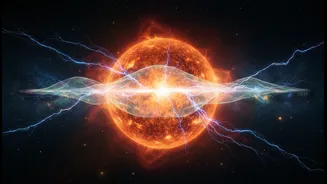
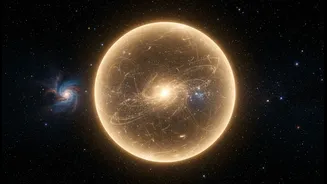
Our solar system exists inside a giant, protective bubble known as the heliosphere. This bubble is 'inflated' by the solar wind, a constant stream of charged particles flowing outward from the sun at supersonic speeds. The heliosphere acts as a crucial
shield, protecting Earth and the other planets from a significant amount of harsh galactic cosmic radiation that permeates our Milky Way galaxy. Without this shield, life on Earth would be exposed to continuous bombardment by high-energy particles. The heliosphere isn’t a perfect sphere; its shape is moulded by its journey through the interstellar medium—the gas and dust that exists between stars. Understanding the structure and boundary of this bubble is fundamental to understanding our place in the galaxy.
A Journey to the Frontier
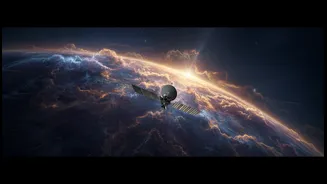
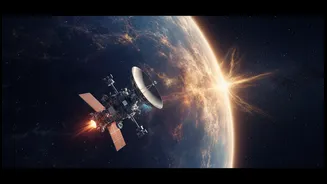
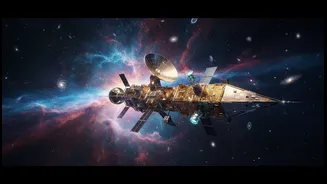
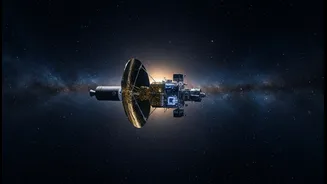
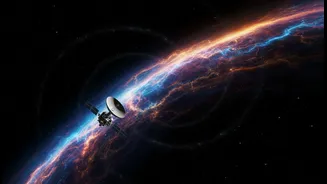
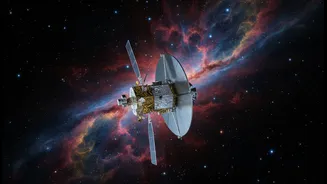
Launched in 2006, NASA’s New Horizons spacecraft is a veteran explorer. After its historic flyby of Pluto in 2015 and the Kuiper Belt object Arrokoth in 2019, its mission was extended. Now, it serves as a deep-space observatory, currently billions of kilometres from Earth. In early July 2026, after a nearly year-long hibernation to conserve resources, the spacecraft woke up and resumed its scientific operations. While it 'slept', its instruments continued to collect data on the environment of the outer heliosphere. Its unique position allows it to measure how the solar wind behaves at extreme distances and interact with material from interstellar space.
Seeing Our Bubble from the Outside In
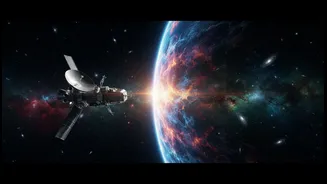
One of the key scientific goals for New Horizons is to study the edge of the heliosphere. As the solar wind pushes outward, it eventually encounters the inward pressure of the interstellar medium, causing it to slow down. This interaction is thought to create a 'wall' of hydrogen at the boundary. From its distant vantage point, New Horizons uses its ultraviolet spectrograph to scan for a faint glow from this hydrogen wall. By measuring this light, scientists can map the structure of our own heliosphere in a way that’s impossible from Earth. This provides a three-dimensional model of our home bubble, revealing its shape and size, and how it interacts with the galaxy around it. Recent data from the probe has already helped confirm that the solar wind slows down significantly—by about 13-15%—as it travels to these far reaches, a slowdown caused by picking up interstellar particles along the way.
A Blueprint for Distant Stars
The Sun is not unique in having a protective bubble. Most, if not all, stars create their own versions, called 'astrospheres'. We can observe these astrospheres around distant stars, but only as faint, faraway objects. We can't see their detailed structure. This is where New Horizons' work becomes a crucial blueprint. By studying our own heliosphere up close and from a unique vantage point, we create a detailed reference model. This model helps scientists interpret the limited data we can gather from other star systems. In effect, understanding our heliosphere provides a guide for understanding the properties of astrospheres across the galaxy. The study of our local bubble allows us to test theories that can then be applied to countless other stars.
The Search for Habitable Worlds
This research has profound implications for the search for life beyond Earth. An astrosphere’s ability to shield planets from galactic cosmic rays could be a key factor in whether a world can become or remain habitable. A star with a weak or compressed astrosphere might expose its planets to deadly levels of radiation. By using our heliosphere as a model, astronomers can better estimate the size and strength of distant astrospheres. This, in turn, helps them narrow down which star systems are the most promising candidates for hosting life. The data sent back from New Horizons, across billions of kilometres, is therefore not just about our solar system's edge; it's a vital piece of the puzzle in understanding the conditions for habitability throughout the cosmos.