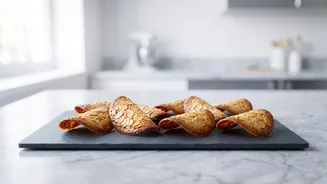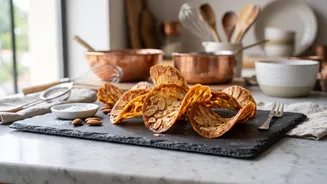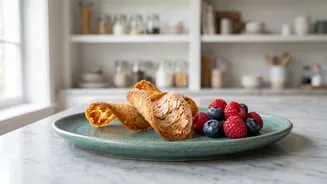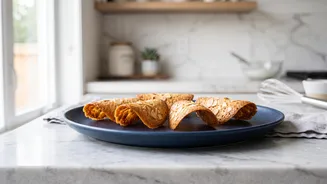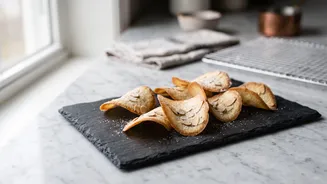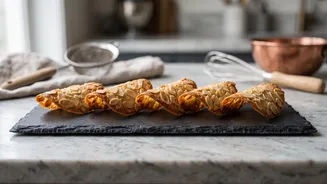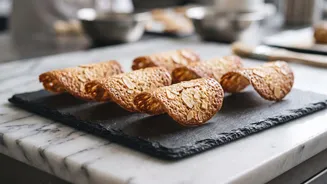





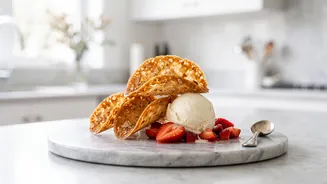
Elegant, delicate, and impossibly crisp, the French almond tuile is a masterpiece of texture and flavour. These thin, curved biscuits, named for the roof tiles they resemble, seem like a treat reserved for fancy patisseries. But what if you could master them
at home?
Understanding the Classic Tuile
A tuile, which is French for 'tile', is a wafer-thin cookie traditionally made with almonds. The magic of the tuile lies in its dual personality: it emerges from the oven soft and pliable, but quickly hardens into a crisp, delicate biscuit. This brief window of flexibility is when the signature curve is created. The goal is not a soft, chewy cookie, but a wafer that snaps. The batter is simple, typically involving egg whites, sugar, flour, melted butter, and sliced almonds. There are no leavening agents like baking soda or powder, as the aim is a flat, crisp wafer rather than a risen, airy cookie.
The Foundation: A Perfect Batter
Achieving the perfect tuile starts with the batter. The consistency should be thin enough to spread easily but not so watery that it runs all over your baking sheet. Most recipes call for a simple whisking of egg whites and sugar until just foamy, followed by folding in the flour, and then finally the cooled melted butter, vanilla extract, and sliced almonds. It is crucial not to over-whip the egg whites. You are not making a meringue; you simply want to combine the ingredients smoothly. Once mixed, some chefs recommend letting the batter rest in the refrigerator for at least 30 minutes. This allows the flour to hydrate fully, which helps in creating a more uniform and crisp biscuit.
The Art of Spreading Thin
The secret to a shatteringly crisp tuile is spreading the batter as thinly and evenly as possible. A thicker biscuit will remain soft in the middle. Place a teaspoon of batter onto a baking sheet lined with a silicone mat or parchment paper. Then, using the back of the spoon, an offset spatula, or even your fingertip, spread the batter into a thin, round circle, about three to four inches in diameter. The sliced almonds should be in a single layer. Don’t overcrowd the baking sheet. Baking only three or four tuiles at a time is highly recommended, especially when you are starting out. This is because you will need to shape them quickly while they are still hot.
Baking to Golden Perfection
Tuiles bake quickly in a moderately hot oven, typically around 180°C (350°F). They usually take between 5 to 8 minutes. You are not looking for a uniformly brown cookie. The perfect tuile will be golden brown and crisp on the edges while the centre remains a pale, creamy colour. The colour is your best indicator of doneness. If you pull them out when they are completely pale, they will not crisp up properly. If you wait until the whole biscuit is dark brown, the delicate almond flavour may turn bitter and they might be too brittle to shape without breaking.
The Race Against Time: Shaping the Curve
This is the most critical and time sensitive step. You have about 30 seconds to shape the tuiles once they are out of the oven before they harden. Working quickly, use a thin metal spatula to lift a hot biscuit from the baking sheet. Immediately drape it over a rolling pin, the side of a wine bottle, or the rim of a small bowl to give it that classic curved shape. Press down gently for a moment to set the curve. Then, move on to the next one. If the cookies harden on the baking sheet before you can shape them, you can try returning the sheet to the oven for about 30 seconds to a minute to make them pliable again. This is why baking in small batches is essential for success.
Troubleshooting and Storage
If your tuiles are soft instead of crisp, they were likely either spread too thickly or underbaked. Try spreading them thinner and leaving them in the oven until the edges are a confident golden brown. If they break while shaping, you might be letting them cool for too long. They must be shaped while hot. Once your perfect, curved tuiles have cooled completely, they need to be stored in an airtight container. Because they are so thin and full of sugar, they readily absorb moisture from the air and will lose their crispness quickly if left out.