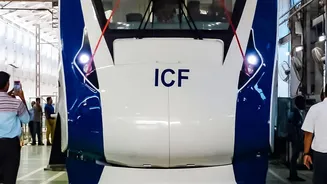








The promise of slashing travel time between Delhi and Haryana’s industrial hubs hangs in the balance. The ambitious Delhi-Panipat Namo Bharat corridor, a high-speed rail link, is navigating a complex web of approvals before construction can begin.
A Vision for High-Speed Connectivity
The
Delhi-Panipat-Karnal Namo Bharat corridor is a proposed 136.3-kilometre semi-high-speed rail line designed to connect the national capital with key cities in Haryana. As part of the National Capital Region Transport Corporation's (NCRTC) broader Regional Rapid Transit System (RRTS), the project aims to dramatically reduce travel times, with trains operating at speeds of up to 160 km/h. Once operational, the journey from Delhi to Panipat is expected to take about an hour, down from the current two to two-and-a-half hours. The full stretch to Karnal could be covered in just 90 minutes, a significant improvement on the nearly four hours it can take by road today. The corridor is planned to run parallel to National Highway 44, featuring 22 proposed stations across Delhi, Sonipat, Panipat, and Karnal.
The State of Approvals
Contrary to headlines suggesting the project is stalled, significant progress has been made on the approvals front, though final sanction is pending. The Haryana government officially approved the corridor's implementation in March 2026. More recently, in November 2026, the National Highways Authority of India (NHAI) granted crucial land-use permissions for construction along the highway. This allows for preliminary activities like pier construction and shifting of power lines, and some initial work has reportedly started on a 22-km stretch between Narela and Murthal. However, the project, with an estimated cost of around ₹33,051 crore, is still awaiting the final green light from the Union Cabinet. Such large-scale infrastructure projects require detailed financial and technical appraisals by the central government before final sanction and funding are released.
Integrating with Haryana's Transit Network
A key feature of the Namo Bharat plan is its integration with other major transport projects. The corridor is designed to connect with the Haryana Orbital Rail Corridor (HORC) near Kundli, creating a comprehensive regional mobility network. The HORC is another significant project aimed at improving connectivity between industrial centres like Kharkhoda, Manesar, and Sohna without needing to transit through Delhi. The Delhi-Panipat RRTS will also feature interchanges with the Delhi Metro at several points, including Sarai Kale Khan and Kashmere Gate, linking commuters to the city's extensive metro system and other RRTS lines like the operational Delhi-Meerut corridor. This multi-modal integration is crucial for creating a seamless travel experience across the National Capital Region.
The Transformative Impact on the Region
Once completed, the corridor is expected to be a game-changer for North Haryana. The dramatic reduction in travel time will make cities like Sonipat, Panipat, and Karnal far more accessible for people working in Delhi and Gurugram. This improved connectivity is anticipated to fuel a real estate boom, making these areas attractive for homebuyers and businesses looking for more affordable alternatives to Delhi. Experts predict a rise in demand for residential and commercial properties along the route. Beyond the economic benefits, the project promises significant environmental advantages by reducing road congestion and encouraging a shift from private vehicles to efficient public transport, thereby helping to curb air pollution in the heavily trafficked region.