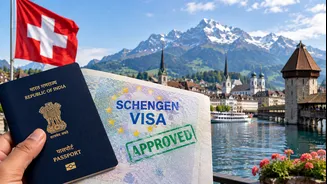









Indians are exploring the world like never before, and new data from 2025 confirms it. With a staggering number of applications, India now ranks third globally for short-stay Schengen visas, signalling a massive travel boom to Europe.
A Nation on the Move
The latest figures
from the European Commission paint a clear picture of India's growing global wanderlust. In 2025, Indian citizens filed a remarkable 1.15 million applications for short-stay Schengen visas, which allow for tourism, business, or family visits of up to 90 days. This places India firmly in the third position for visa demand worldwide, trailing only China (1.81 million) and Turkey (1.27 million). This isn't just a statistic; it's a testament to a nation's expanding economic horizons and a burgeoning desire to experience European culture, history, and landscapes. The sheer volume of applications underscores India’s importance as a critical and rapidly growing market for European tourism.
Behind the European Travel Boom
Several factors are fuelling this incredible surge in demand. At its core is India's expanding middle class, with rising disposable incomes making international travel more accessible than ever before. This economic empowerment is coupled with a demographic dividend; a young, aspirational population is increasingly curious about the world, often inspired by social media and a desire for unique experiences. Furthermore, the trend extends beyond just tourism. A significant number of Indians are travelling for business, while Europe is also becoming a popular destination for higher education, offering affordable, high-quality alternatives to traditional destinations. Improved air connectivity and a growing trend of women, including solo travellers, undertaking international trips have also contributed significantly to this boom.
India's Favourite European Spots
While the Schengen Area covers a vast expanse of Europe, Indian travellers have clear favourites. In 2025, Switzerland emerged as the top destination for Indian applicants, a country long romanticised by Bollywood. It was closely followed by France, with the allure of Paris, and Germany, a major hub for both business and leisure. Italy and the Netherlands also rank among the most popular choices. However, travel patterns are evolving. While first-time visitors often stick to iconic cities like Paris, Rome, and Interlaken, there is a growing trend of repeat travellers and smaller groups exploring beyond the capitals, seeking regional experiences in places like France's countryside or Czechia's South Moravia.
The Hurdle of Rejection
The surge in applications is, however, met with a significant challenge: visa rejections. In 2025, the rejection rate for Indian applicants stood at 15.8%, slightly above the global average of 14.6%. This translated to over 181,000 applications being denied, resulting in disappointment and significant financial losses in non-refundable fees. Rejection rates vary dramatically by country. While nations like Germany (10.5%), Italy (12.7%), and Switzerland (13.6%) had relatively lower refusal rates for Indian applicants, others were far stricter. For instance, Greece had a rejection rate of 33%, while for Slovenia, it was as high as 46.1%. Common reasons for refusal often boil down to factors like insufficient proof of funds, an inconsistent travel itinerary, or doubts about the applicant's intention to return to India.
Navigating a Crowded Path
For Indians dreaming of a European getaway, this new landscape of high demand requires strategic planning. The most crucial takeaway is to apply well in advance, as appointment slots at visa centres get booked up quickly, especially ahead of peak travel seasons. Meticulous documentation is more important than ever. Applicants should ensure they provide a clear, logical itinerary, have valid travel insurance, and present strong financial statements and proof of ties to India to demonstrate their intent to return. Given the higher-than-average rejection rate, some travellers are now proactively opting for travel insurance policies that include riders to refund the non-refundable visa fee in case of a rejection, mitigating some of the financial risk. Understanding these dynamics is key to successfully navigating the process and turning a European travel plan into a reality.