




Listening for Cosmic Whispers
The Laser Interferometer Gravitational-Wave Observatory (LIGO) isn’t a telescope; it's more like a cosmic microphone. It consists of two identical facilities in the United States, each an L-shaped instrument with arms four kilometres long. Inside these
arms, a powerful laser is split and bounced between ultra-pure mirrors. When a gravitational wave—a ripple in spacetime itself—passes through Earth, it stretches and squeezes the distance between these mirrors by an infinitesimal amount, far smaller than the width of a proton. By detecting this minuscule change, scientists can listen in on some of the universe's most violent events, such as the collision of black holes and neutron stars.
The Holy Grail: Neutron Star Collisions
While black hole mergers are dramatic, the collision of two neutron stars is a true scientific prize. Neutron stars are the super-dense remnants of massive stars that have exploded. A single teaspoon of neutron star material would weigh about a billion tonnes on Earth. When two of these objects spiral into each other, they don't just produce gravitational waves; they also create a spectacular explosion of light called a kilonova. This light allows traditional telescopes to join the party, creating a new field called 'multi-messenger astronomy'. These events are thought to be the cosmic forges where most of the heavy elements in the universe, like gold and platinum, are created. By studying them, we can unlock secrets about the life cycle of stars and the fundamental nature of matter.
A Nanometer-Sized Problem
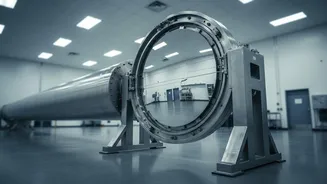
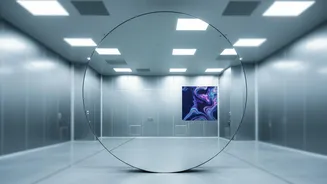
LIGO's incredible sensitivity is also its greatest weakness. The powerful lasers, approaching one megawatt, which are needed to detect these faint cosmic signals, also create a problem. Even though LIGO's 40-kilogram mirrors are some of the most perfect optical devices ever created, they still absorb a tiny amount of laser light. This absorbed energy heats the mirrors, causing their shape to distort by just a few nanometers. This 'thermal warping' creates background noise that can mask the faint whispers of a distant neutron star merger, limiting how far into the universe the detectors can effectively see.
A Clever, Cool-Headed Solution
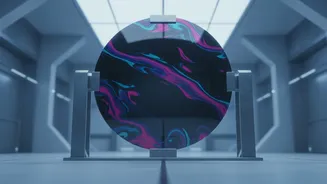
Scientists have now devised an elegant solution to this heating problem. Researchers, including a team from the University of California, Riverside, have developed a technique that uses commercial thermal imaging cameras to take an 'infrared picture' of the mirror's surface. By combining this thermal map with sophisticated models of heat flow, they can precisely reconstruct how the mirror is being distorted from the inside out. This allows them to apply a corrective pattern of heating, effectively creating an opposite distortion that cancels out the original warping. It is an incredibly precise form of noise cancellation for one of the most sensitive instruments on Earth.
A New Era of Cosmic Discovery
The implications of this new technique are profound. Researchers estimate that this upgrade could boost the sensitivity of LIGO by up to 31 percent. This doesn't just mean we can see a little bit farther. Because the searchable volume of space increases with the cube of the distance, this modest-sounding improvement could dramatically increase the number of gravitational-wave events we detect. Instead of catching a few neutron-star mergers per year, we could be on the cusp of observing them much more frequently, turning rare discoveries into regular occurrences. This would provide a wealth of new data, helping astronomers build a more complete census of the cosmos and test the limits of physics.