







Beyond Ones and Zeros
First, let's demystify the terminology. Traditional computers, from your smartphone to the most powerful data centres, think in 'bits'. A bit is a simple switch, either a 1 or a 0. Quantum computers, however, use 'qubits'. Thanks to the strange rules
of quantum mechanics, a qubit can be a 1, a 0, or both at the same time—a state called superposition. This ability to exist in multiple states at once grows exponentially with each added qubit, allowing quantum computers to explore a vast number of possibilities simultaneously. This makes them exceptionally powerful for solving specific, complex problems that would take a classical computer billions of years, such as designing new medicines, creating novel materials, and cracking complex optimisation problems in finance and logistics.
The 'Superconducting' Advantage
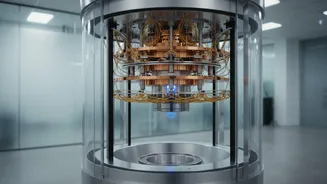
The headline mentions a “superconducting” system. This refers to the specific technology used to build the qubits. Superconducting qubits are tiny circuits made from materials like aluminium or niobium that, when cooled to temperatures colder than deep space—close to absolute zero (-273°C)—lose all electrical resistance. In this ultra-cold, controlled environment, the circuits behave like 'artificial atoms,' allowing their quantum states to be precisely manipulated with microwave pulses. This method is one of the leading approaches to building scalable quantum computers and is pursued by global tech giants. The need for this extreme cooling is also what makes building and maintaining these systems so challenging and expensive.
Why Local Access Is a Game-Changer
Until recently, Indian researchers wanting to experiment with real quantum hardware primarily relied on cloud access to systems located overseas, provided by companies like IBM. While valuable, this remote access has limitations. The announcement of a locally accessible system, such as the recently established experience centres and open-access testbeds, marks a pivotal shift. Having a domestic machine allows for more profound, hands-on experimentation. Researchers can test hardware-specific ideas, develop custom control mechanisms, and better understand the nuances of the system—tasks that are difficult or impossible via a remote cloud interface. It also dramatically lowers the barrier to entry for startups and academic institutions, fostering a domestic talent pool that is crucial for building a robust quantum ecosystem.
Unlocking New Research Frontiers
This new accessibility is set to energize research across multiple fields. In material science, scientists can simulate molecular interactions to design new catalysts or more efficient batteries. Pharmaceutical researchers can model complex proteins to accelerate drug discovery. In finance, they can develop algorithms to optimise investment strategies and better assess risk. Furthermore, the system will be a critical tool for advancing quantum computing itself. Researchers can work on developing better error-correction techniques—a major hurdle in the field—and design more efficient quantum algorithms. Institutions like TIFR, IISc, and various IITs have been at the forefront of this research, and local access will only accelerate their work.
India's Quantum Leap
This development is a significant milestone for the National Quantum Mission (NQM), an ambitious government initiative launched to make India a leading nation in quantum technology. With a substantial budget, the NQM aims to foster R&D, build indigenous quantum computers, and create a vibrant ecosystem of startups and skilled professionals. Initiatives like the Alliance University and QpiAI partnership in Bengaluru to create a hands-on experience centre, and open-access testbeds in places like Amaravati, are tangible results of this national push. By providing the tools and infrastructure for homegrown innovation, India is not just participating in the global quantum race but is positioning itself to become a key player in this transformative technology's future.