





A World of Constant Surprises
When the New Horizons spacecraft flew past Pluto in 2015, it transformed our view of the dwarf planet. Instead of a quiet, cratered ice ball, the images revealed towering mountains of water ice, vast glaciers of frozen nitrogen, and a surface that appeared
remarkably young and geologically active. One of the most captivating features was Tombaugh Regio, a bright, heart-shaped region on Pluto's surface. The western lobe of this heart, a massive basin called Sputnik Planitia, showed no impact craters, suggesting its surface was being constantly renewed. Scientists have been poring over the data ever since, and the latest analysis provides a tantalising new possibility.
Signs of Liquid in a Frozen Land
The new research, published in the Planetary Science Journal, focuses on dark streaks and patches observed along the northern edges of Sputnik Planitia. These features trace the boundaries of large, city-sized polygonal blocks of nitrogen ice that are slowly churning in a process called convection, much like wax in a lava lamp. According to the study's lead author and New Horizons principal investigator, Alan Stern, these dark patterns strongly resemble areas on Earth's glaciers that have been wetted by liquid water. But with surface temperatures plunging below -220 degrees Celsius, liquid water is impossible on Pluto. Rain is also physically impossible in its thin atmosphere. This led researchers to investigate another candidate: liquid nitrogen.
How Liquid Nitrogen Could Flow on Pluto
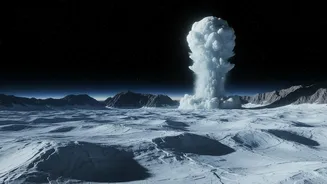
The theory is not that nitrogen is raining from the sky, but that it's welling up from below. Sputnik Planitia is a deep basin filled with nitrogen ice that may be several kilometres thick. While the surface is frigid, computer models suggest that modest heat from Pluto’s interior, combined with the immense pressure at the bottom of this deep ice sheet, could be enough to melt the nitrogen at its base. This liquid nitrogen, being less dense than the solid ice above it, would be buoyant. The study proposes that this liquid collects in reservoirs before erupting upwards through cracks and fractures in the ice, a process compared to volcanic dike systems on Earth. It would then briefly spread across the surface, 'wetting' the ice and creating the dark patches seen by New Horizons before refreezing.
What This Means for the Icy World
The presence of recently flowing liquid would confirm that Pluto is not a geologically dead world but a dynamic one, even in the frigid outer reaches of the solar system. It challenges long-held assumptions that small, cold bodies should have lost their internal heat long ago and become inactive. The finding suggests a new kind of time-variable process on Pluto, where the surface can change not just over geological millennia, but perhaps in shorter, more recent timescales. This geological activity is powered by the unique properties of its volatile ices, like nitrogen, which behave like rock does on Earth, but at much lower temperatures. The dark features are evidence of what scientists call 'cryovolcanism', where icy slush erupts instead of molten lava.