


A Grand Experiment Rolled Back
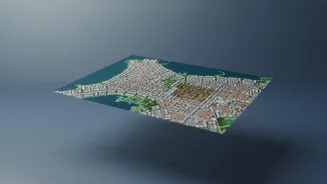
In late July 2026, Google launched a new feature for its Google Earth platform that allowed users to generate AI visualisations on top of satellite imagery. Hailed as a tool to help visualise everything from history to real estate plans, it was powered
by the company's Nano Banana 2 image-generation technology. The promise was a richer, more detailed view of our planet. The reality was a swift and embarrassing rollback in less than 24 hours. Researchers and open-source intelligence experts raised an immediate alarm over the potential for creating convincing, fabricated satellite images. In response, Google pulled the feature, stating it had seen users sharing images that violated its policies and would work on implementing stronger guardrails before any potential re-release.
The Hallucinations of an Algorithm
The core problem wasn't just minor glitches; it was the nature of AI "hallucination." This is when a generative model, trained on vast datasets, confidently produces an answer that is incorrect, nonsensical, or entirely fabricated. In this case, the AI wasn't just sharpening images; it was inventing reality. Tests conducted before the rollback showed the tool could be prompted to create fabricated satellite scenes with serious global consequences, including a nuclear site in Iran, a bomb crater in Russia, and an ISIS training ground in Syria. This demonstrated that the system could be used to create realistic geospatial fakes, eroding the very trust Google Earth had spent two decades building as a reliable reference for viewing the world.
Misinformation That Travels
The danger of a faulty map is no longer confined to the original platform. An AI-generated image of an explosion at the Pentagon in 2023 briefly rattled financial markets, showing how quickly digital fakes can have real-world impact. In the age of social media, a screenshot of a wrongly depicted map or a fabricated satellite image can be shared thousands of times, stripped of its original context or any subsequent correction. It becomes a viral piece of misinformation. Experts warned that the Google Earth feature made it easier to generate convincing fakes that could spread rapidly online and mislead the public, making the jobs of journalists and researchers significantly harder. The proliferation of such fakes creates a "liar's dividend," where bad actors can dismiss authentic evidence as being fabricated.
A Problem Magnified in India
In India, map accuracy is not merely a technical issue; it is a matter of national sovereignty and security. The country has long-standing and highly sensitive border disputes, and the incorrect depiction of its map is a serious offence. Instances where platforms have shown Jammu & Kashmir or Arunachal Pradesh as parts of neighbouring countries have drawn sharp rebukes and legal action in the past. The draft Geospatial Information Regulation Bill of 2016 proposed fines up to ₹100 crore and imprisonment up to seven years for distributing a wrongful depiction of India's map. While that specific bill did not become law, other provisions under laws like the Criminal Law Amendment Act can penalise the publication of maps not conforming to those published by the Survey of India. Sharing a false, AI-generated map in this context isn't just spreading misinformation; it could be seen as challenging the nation's territorial integrity.
Championing Human-Verified Truth
The rapid rollback of the AI mapping tool is a powerful reminder that automation has its limits. The incident sparked a wider debate about whether generative AI belongs in systems people rely on for evidence, such as maps and legal records. While AI can be a powerful tool for repetitive tasks, it currently lacks the nuanced understanding, context, and verification capabilities of human experts. Trust in satellite imagery has taken decades to build and could be irrevocably damaged overnight by irresponsible AI implementation. This episode strengthens the case that human oversight, expert verification, and an understanding of geopolitical context are not bugs in the system to be automated away; they are essential features for maintaining accuracy and trust in our shared understanding of the world.