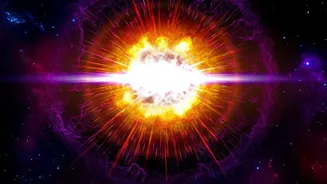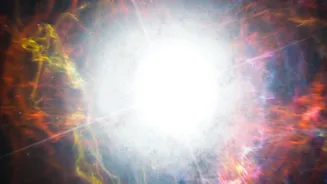




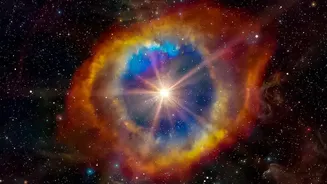
Imagine a single point of light suddenly burning brighter than a billion suns. This isn't science fiction; it's a supernova, the spectacular death of a star. For a few brilliant weeks, it can outshine its entire host galaxy. So, what causes this cosmic
firework?
The Life of a Star
Stars are immense nuclear reactors. For millions or billions of years, they exist in a delicate balance. Deep in their cores, the intense pressure and heat fuse lighter elements like hydrogen into heavier ones like helium, releasing a tremendous amount of energy. This outward pressure from fusion perfectly counteracts the crushing inward pull of the star's own gravity. This process continues, creating progressively heavier elements—carbon, oxygen, and so on—in an 'onion-like' structure of shells. But this cycle has a limit.
When the Fuel Runs Out
The fusion process stops at iron. Fusing iron atoms doesn't release energy; it consumes it. For a massive star, typically one more than eight times the mass of our Sun, this is the beginning of the end. With the nuclear furnace in the core extinguished, the outward pressure vanishes. Gravity, which has been held at bay for the star's entire life, suddenly wins. In a fraction of a second, the star's core collapses catastrophically, shrinking from the size of Earth to a dense ball just a few kilometres across.
The Ultimate Cosmic Rebound
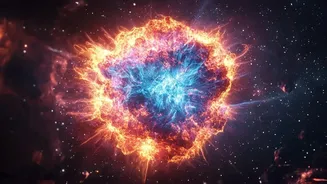
This collapse happens at staggering speeds, up to a quarter of the speed of light. The core becomes so dense that protons and electrons are forced together to form neutrons, creating an incredibly dense object known as a neutron star. This new, ultra-dense core resists further collapse, causing the infalling material to rebound in a titanic shockwave. This shockwave, supercharged by a blast of elusive particles called neutrinos from the core, rockets outward, tearing the rest of the star apart in a monumental explosion. This is a core-collapse, or Type II, supernova.
Another Path to Annihilation
There is another common type of stellar explosion: the Type Ia supernova. This kind doesn't start with a massive star, but with a small, dense stellar remnant called a white dwarf. If a white dwarf is in a binary system with another star, it can siphon material from its companion. Over time, it can accumulate enough mass to exceed a critical limit, known as the Chandrasekhar limit. This triggers a runaway thermonuclear reaction that completely obliterates the white dwarf in a brilliant, uniform explosion. Because they explode at a consistent mass, Type Ia supernovae have a predictable peak brightness, making them invaluable 'standard candles' for astronomers to measure vast cosmic distances.
A Beacon of Unimaginable Brightness
So why is the explosion so luminous? The brightness comes from several sources. The initial shockwave itself is immensely hot and energetic. More importantly, the explosion creates a massive amount of radioactive material, particularly an isotope called nickel-56. As this nickel decays into cobalt and then into stable iron, it releases a huge amount of energy in the form of light. In essence, the supernova releases a star's lifetime worth of stored energy in a matter of weeks. The result is a brief but spectacular burst of light that can radiate with the power of several billion suns, temporarily outshining the combined light of all the other stars in its galaxy.