








A Landmark Moment for Make in India
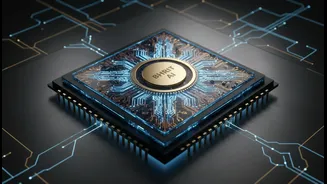
India has officially entered a new phase of its technological journey. An indigenous artificial intelligence chip, a cornerstone of the nation’s ambitious semiconductor strategy, has entered the crucial trial production phase. This development is spearheaded
by the Centre for Development of Advanced Computing (C-DAC), a government research and development organization with a long history of driving India's supercomputing goals. The news signifies a major victory for the 'Atmanirbhar Bharat' and 'Make in India' initiatives, positioning the country as a budding player in the highly competitive global semiconductor landscape.
What is This AI Chip For?
While specific details about the processor remain under wraps, it is described as an AI 'inference' chip. In the world of artificial intelligence, 'training' a model requires massive computational power (like teaching a student), while 'inference' is the process of using that trained model to make predictions or decisions in the real world (like the student taking a test). This Indian-designed chip is aimed at the latter, intended to power AI applications within domestic servers, IT infrastructure, and public services. The goal is to create a homegrown alternative to chips from global giants like Nvidia, reducing reliance on foreign technology for critical national infrastructure.
Ahead of Schedule
The headline's claim of being 'years before target' is a powerful one. The broader official timeline for delivering a homegrown AI chip is set for 2029 or 2030, as part of the new ₹1.27 trillion Semicon 2.0 mission approved in July 2026. Entering trial production now suggests that the foundational design and development work, which has been ongoing for some time, is progressing faster than publicly anticipated. This acceleration is a testament to the focused efforts under the India Semiconductor Mission. For this trial phase, C-DAC has partnered with HCL Infosystems, which will be responsible for validating the chip’s design and performance to ensure it meets demanding real-world standards.
The Strategic Imperative
Developing a sovereign chip is not just a matter of economic ambition; it's a strategic necessity. Recent global events have highlighted the vulnerabilities of complex supply chains, and many nations have faced restrictions on accessing high-performance chips. By developing its own chip and owning the intellectual property, India aims to safeguard its public services and AI development from such geopolitical pressures. C-DAC itself was founded in 1988 for a similar reason: to build indigenous supercomputers after India was denied access to American technology. Its first supercomputer, the PARAM 8000, was a result of that push for self-reliance.
The Road to a Full Ecosystem
This AI chip is a critical piece of a much larger puzzle. The government's Semicon 2.0 programme aims to build out the entire semiconductor value chain, from design and research to advanced packaging and manufacturing. While C-DAC is leading this specific government project, other players are also emerging. Kerala-based startup Netrasemi, for instance, has also launched its own AI chip for edge devices, with volume production slated for 2027. Furthermore, with the first major commercial fab by Tata Electronics expected to come online by 2028, the dream of not just designing but also manufacturing chips at scale within India is getting closer to reality.