




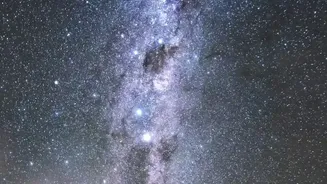
A Galaxy Bent Out of Shape
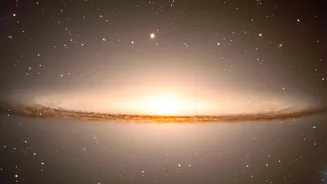
For decades, astronomers have known that the Milky Way has a curious feature: its disc is not perfectly flat. If you could view it from the side, you would see that the outer edges are bent, with one side curving up and the other down, much like a warped
vinyl record. This is just one of several puzzles about our galaxy's structure. Another mystery surrounds the motion of stars in the galactic halo, the vast, spherical cloud of stars that envelops the main disk. Stars in the disc zip around the galactic center at about 220 kilometers per second, but those in the halo move at a much more leisurely pace. For years, scientists have wondered what could cause these anomalies.
The Prime Suspect: A Cosmic Collision
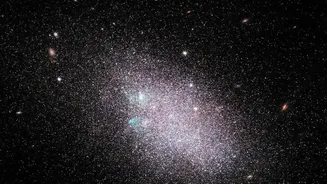
A growing body of evidence points to a violent event in our galaxy's distant past: a head-on collision with a smaller, dwarf galaxy. The prime suspect is a galaxy known to astronomers as the Gaia-Sausage-Enceladus, often nicknamed the 'Gaia Sausage' because of the sausage-shaped path its remnant stars now follow. This collision, which occurred roughly 8 to 11 billion years ago, was not a gentle merger. The far more massive Milky Way tore the intruder apart, absorbing its stars and gas in a process of cosmic cannibalism that reshaped our galaxy forever.
Flipping the Galactic Disc
The latest research, presented in July 2026, proposes a truly dramatic outcome of this ancient crash. Using powerful supercomputer simulations, astronomers at Durham University have shown that a head-on collision like the one with the Gaia Sausage could have caused the entire disc of the Milky Way to flip by more than 90 degrees. This 'disc flip' wasn't instantaneous; it was a gradual reorientation that would have taken hundreds of millions of years. This startling theory provides a compelling explanation for the slow-moving stars in the halo. The simulations showed that galaxies that experience such a flip end up with slowly rotating haloes, just like the one observed in the Milky Way.
Reading the Stellar Crime Scene
This groundbreaking research would not be possible without the European Space Agency's Gaia mission. Launched in 2013, the Gaia space telescope is creating an unprecedented 3D map of our galaxy, precisely measuring the positions, movements, and properties of nearly two billion stars. It was Gaia data that first revealed the ancient collision in 2018 and has allowed astronomers to trace the motions of stars that were once part of the Gaia Sausage. By analyzing this stellar 'crime scene,' scientists can effectively rewind time and model the cataclysmic events that shaped our cosmic home. These collisions didn't just alter the galaxy's shape; they also triggered massive bursts of star formation. Some studies suggest that one such wave of star birth, following an earlier collision with the Sagittarius dwarf galaxy, may have even led to the formation of our own Sun.
A Violent and Vibrant History
The idea of our galaxy being violently flipped on its side can be unsettling, but it highlights a fundamental truth about the cosmos: galaxies grow and evolve through chaotic and violent interactions. These mergers are not rare events; they are a standard part of galactic formation. The Milky Way's peculiar shape is a living record of its dramatic past. The stars in its halo, the warp in its disc, and even its overall orientation are all echoes of ancient collisions. This new understanding paints a picture of a galaxy with a much more dynamic and turbulent history than was previously imagined, a story written in the movement of the stars themselves.