






A New Cosmic Surveyor
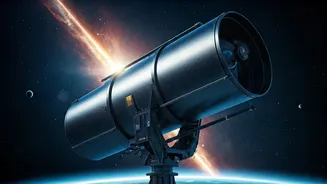
Scheduled to launch on a SpaceX Falcon Heavy rocket on August 30, 2026, the Nancy Grace Roman Space Telescope is a next-generation observatory designed not just to see deeper, but wider. Named after NASA's first chief of astronomy, Nancy Grace Roman,
who was instrumental in the creation of the Hubble program, this new telescope carries on her legacy by aiming to answer some of the biggest questions in astrophysics. While it shares the same 2.4-meter primary mirror size as Hubble, its power lies in a fundamentally different approach to cosmic observation. Instead of focusing on individual targets in painstaking detail, Roman is built for sweeping surveys, capturing enormous panoramas of the universe with the same sharpness as its famous predecessor. This shift in strategy is what will allow it to map the universe on an unprecedented scale.
A Universe in Wide-Angle
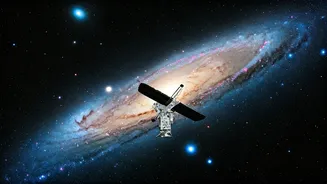
The key to Roman's power is its Wide Field Instrument (WFI). This state-of-the-art camera will have a field of view at least 100 times larger than Hubble's infrared camera. To put that in perspective, a single image from Roman will contain the equivalent detail of 100 Hubble pictures. While it took Hubble over 400 individual pointings to survey a patch of sky, Roman will be able to cover a similar area with just two. This incredible efficiency means that in its five-year primary mission, Roman will be able to map more of the universe than any observatory before it. This isn't just an incremental improvement; it's a paradigm shift that will transform astronomy from a process of targeted observation to one of big-data statistical analysis, enabling scientists to study the cosmos on a grand, systematic scale.
Illuminating the Dark Universe
Two of the most profound mysteries in science are dark energy and dark matter, the invisible components that are believed to make up roughly 95% of the universe. Roman's primary mission is to tackle these unknowns head-on. Dark energy is the name given to the mysterious force causing the expansion of the universe to accelerate. Roman will study this by measuring light from a billion galaxies and observing distant stellar explosions called Type Ia supernovae. By creating a vast 3D map of the universe, scientists can trace the distribution of galaxies and how that structure has changed over cosmic time, revealing dark energy's influence. The telescope will also map the presence of dark matter by observing how its gravity bends and distorts the light from distant galaxies—a phenomenon known as weak gravitational lensing. These massive datasets will provide the most precise measurements yet of how these dark components have shaped our universe.
A New Census of Alien Worlds
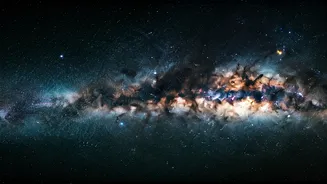
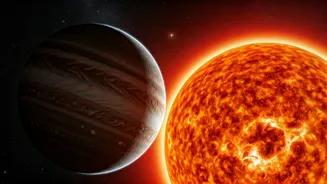
Beyond cosmology, Roman is set to revolutionise the hunt for exoplanets. It will conduct a massive survey of the central bulge of our Milky Way galaxy to find thousands of new worlds. Instead of the transit method used by telescopes like Kepler, which watches for the dip in a star's light as a planet passes in front of it, Roman will primarily use a technique called gravitational microlensing. This effect occurs when a star and its planet pass in front of a more distant star, and their combined gravity acts like a cosmic magnifying glass, briefly brightening the background starlight. This method is sensitive enough to find planets with masses as low as Mars, and it can detect worlds much farther from their stars than other techniques allow, including so-called 'rogue planets' that wander the galaxy untethered to a star. The survey is expected to provide a comprehensive census of planets in our galaxy, helping scientists understand how common systems like our own truly are.