




A Partnership for the Final Frontier
NASA and the U.S. Department of Energy (DOE) have formalized a powerful collaboration to develop the next generation of space-based nuclear technologies. This partnership combines NASA's decades of experience in space exploration with the DOE's extensive
expertise in nuclear science and reactor development. A recent Memorandum of Understanding, signed in October 2026, accelerates their joint efforts on everything from advanced research and fuel production to testing and mission integration. The goal is to supercharge deep-space exploration by creating safe and reliable nuclear systems for both propulsion and surface power, enabling missions that are currently impossible with conventional technology. This collaboration builds upon a long history, but the new agreement signals a focused push, driven by the ambitious goals of the Artemis program and the long-term vision of sending humans to Mars.
Why Solar Isn't Enough
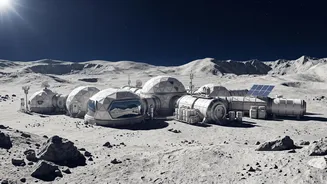
For decades, solar panels have been the workhorse of space missions, but they have significant limitations for deep-space exploration. Solar arrays become less effective the farther a spacecraft travels from the Sun. On Mars, for instance, sunlight is about 43% as intense as it is near Earth. This problem is compounded by recurring, planet-wide dust storms that can last for weeks or even months, drastically reducing the sunlight that reaches the surface and potentially ending a mission, as happened with the Opportunity rover. On the Moon, the challenges are different but just as severe. A single lunar night lasts for 14.5 Earth days, plunging temperatures to extreme lows and cutting off any solar-dependent systems from their power source. For a permanent base, especially one located in a permanently shadowed crater where water ice might exist, a continuous power source independent of sunlight is not a luxury—it's a necessity.
Fission Power for the Surface
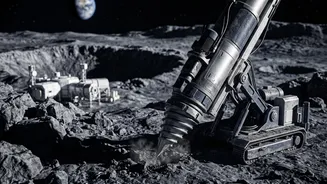
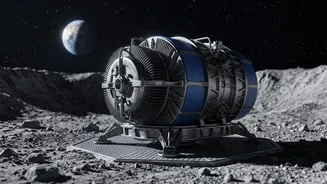
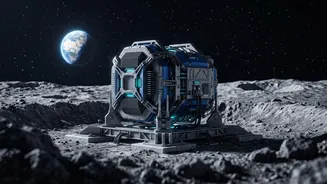
To solve the surface power problem, the partnership is focused on the Fission Surface Power (FSP) project. The goal is to develop a small, lightweight nuclear fission reactor that can provide a steady stream of electricity on the Moon and, eventually, Mars. One concept in development is a 40-kilowatt class fission system, which is enough energy to continuously power about 30 average households for ten years. These reactors are designed to be robust and operate without human intervention for a decade. Unlike large terrestrial nuclear plants, these space-rated microreactors are compact and designed with safety as a primary driver, ensuring they are only activated once safely away from Earth. The plan is to first demonstrate the technology on the Moon under the Artemis program, using the lunar surface as a testing ground to reduce risks before deploying similar systems for the first crewed missions to Mars.
The Future of Space Travel
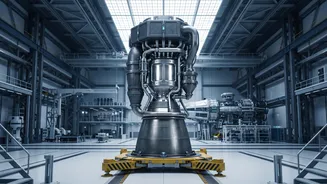
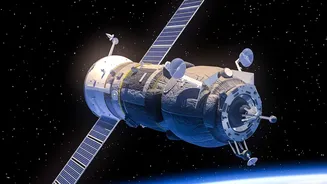
Beyond powering bases, nuclear technology is set to revolutionize how we travel through space. Nuclear Electric Propulsion (NEP) is a game-changing technology that uses a reactor to generate electricity, which then powers highly efficient electric thrusters. While these thrusters produce less force than chemical rockets, they can operate continuously for long periods, gradually accelerating a spacecraft to immense speeds. This high efficiency means a spacecraft needs far less propellant, freeing up mass for more science equipment and crew supplies. Most importantly, NEP could drastically reduce the transit time for a human mission to Mars. A shorter journey—potentially cutting a three-year round trip down to two—is crucial for astronaut health, as it significantly reduces their exposure to dangerous deep-space radiation. Faster travel and more payload capacity make long-duration missions safer and more feasible, paving the way for humanity's expansion across the solar system.