




A Mechanic for the High Frontier
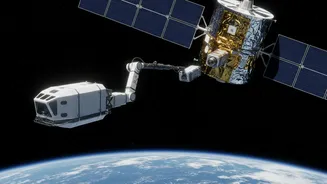
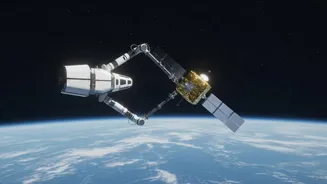
Imagine roadside assistance, but 22,000 miles above the Earth. That’s the simplest way to think about the Mission Robotic Vehicle, or MRV. Developed by Northrop Grumman's subsidiary, SpaceLogistics, the MRV is a first-of-its-kind spacecraft designed specifically
to service other satellites directly in geosynchronous orbit (GEO). This orbit is a critical location for hundreds of communication, weather, and national security satellites. Launched in July 2026, the MRV is not just a concept; it's the beginning of a new commercial enterprise in space. The program is a public-private partnership with the U.S. Defense Advanced Research Projects Agency (DARPA), which developed the advanced robotic system as part of its Robotic Servicing of Geosynchronous Satellites (RSGS) initiative. After its launch aboard a SpaceX Falcon 9, the MRV began a slow, year-long journey using its efficient electric propulsion system to reach its operational altitude in GEO.
More Than Just a Helping Hand
At the heart of the MRV are two highly dexterous robotic arms developed by the U.S. Naval Research Laboratory. These are not simple grappling hooks. Each arm has seven joints, giving it a range of motion that mimics a human arm, and can be fitted with a suite of specialized tools. This allows the MRV to perform a variety of complex tasks on satellites that were never designed to be serviced. The primary mission includes inspection, where it can get a close-up look at a malfunctioning satellite to diagnose problems. It can also relocate satellites, acting as a space tug to move them to new orbital slots. Perhaps most impressively, it can actively repair and upgrade satellites. One of its key tasks will be to install Mission Extension Pods (MEPs), which are essentially propulsion “jet packs” that attach to a client satellite and can extend its operational life by six years or more. The MRV also carries a refueling module, setting the stage for future missions where it could top up a satellite's fuel tanks.
The End of Disposable Satellites?
The implications of this technology are enormous. The traditional satellite business model has been to launch a satellite and operate it until it fails or runs out of fuel, at which point it is abandoned. This is an incredibly wasteful approach, both economically and environmentally. A faulty component on a multi-million dollar asset could previously render it useless, contributing to the growing problem of space debris. By making satellites serviceable, the MRV fundamentally changes this calculus. Satellite operators can now extend the life of their most valuable assets, generating more revenue and deferring the immense cost of building and launching a replacement. This creates a more sustainable space ecosystem, reducing the creation of new space junk and potentially enabling missions to remove existing debris. The shift is from a 'launch and leave' mentality to a sustainable, circular economy in orbit.
A New Business Model in Orbit
This isn't a government science experiment; it's a commercial service. SpaceLogistics already has customers, including satellite operators Intelsat and Optus, lined up for its life-extension services. The MRV represents the second generation of the company's servicing vehicles. The first generation, known as Mission Extension Vehicles (MEVs), docked permanently with a client satellite to provide propulsion. The MRV is far more advanced, able to service multiple clients robotically before moving on to the next. This capability is jump-starting an entirely new commercial market for on-orbit servicing, a sector projected to grow into a multi-billion dollar industry. The success of the MRV could also influence how future satellites are built, with manufacturers potentially designing them with serviceability in mind from the start, featuring standardized ports for refueling and component swaps. While the primary mission is commercial, the dual-use nature of such a capable robotic spacecraft has also been noted, with potential applications in national security.