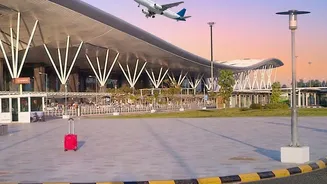









West Bengal is embarking on a major aviation overhaul, blending a rapid two-year airport construction blitz with a massive, decade-long investment strategy. The plan aims to double the state's airports and reshape its economic and tourism landscape.
The Grand Vision: Doubling Down on Airports
At
the heart of the state's new strategy is a landmark agreement between the Centre and the West Bengal government to dramatically expand regional air connectivity. The core of the short-term plan is to develop four new airports within the next two years, effectively doubling the state's functional airport count from four to eight. This initiative falls under the Centre's UDAN (Ude Desh ka Aam Naagrik) scheme, which is designed to bring air travel to underserved regions. The four locations set for this rapid development are Charra in Purulia, Kalaikunda in Paschim Medinipur, Balurghat in Dakshin Dinajpur, and Hasimara in Alipurduar. This aggressive timeline signals a concerted effort to quickly enhance connectivity for passengers and businesses in districts far from Kolkata.
A Decade of Investment: The Financial Blueprint
Supporting this immediate push is a substantial long-term financial commitment. The Union Civil Aviation Minister, K. Rammohan Naidu, announced that ₹29,000 crore will be spent under the UDAN scheme in West Bengal over the next ten years. This decade-long funding ensures that the vision extends beyond just building airstrips. The Memorandum of Understanding (MoU) outlines a collaborative approach: the state government is responsible for providing the necessary land and basic infrastructure like power and water, while the Airports Authority of India (AAI) will manage the development of airport infrastructure and subsequent flight operations. This long-term financial backing is intended to not only build new facilities but also to ensure they are modern, efficient, and future-ready.
The Short-Term Push: What Gets Built First
The two-year plan leverages existing infrastructure where possible. At Kalaikunda and Hasimara, the strategy involves creating civil enclaves at existing Air Force bases, which already possess 2,700-metre runways capable of handling narrow-bodied aircraft like the Airbus A320 and Boeing B737. For Balurghat, the project involves reviving and expanding an existing airport on land already owned by the AAI. In Purulia, a new airport will be developed at Charra, the site of a historic airstrip built during World War II. This mix of greenfield and brownfield projects is designed to deliver operational airports faster than building everything from scratch. The state has committed to providing the required land—25 acres for Hasimara and 37 for Kalaikunda—to move the projects forward.
Beyond the New Four: Upgrades and Future Ambitions
The plan's scope extends beyond the four new airports. The state and Centre have also committed to strengthening existing airports at Kolkata, Bagdogra, and Durgapur (Andal). Bagdogra, the gateway to North Bengal and Sikkim, is already undergoing a major expansion with a new terminal building designed to handle up to 10 million passengers annually, with a completion target of March 2027. Furthermore, there is strong central backing for a long-discussed second major airport for the Kolkata region to ease congestion at Netaji Subhas Chandra Bose International Airport. The state government has identified 2,000 acres in Kalyani for this proposed greenfield airport. There are also calls to revive and upgrade airports at Malda and Cooch Behar in a future phase, making the strategy a comprehensive, state-wide aviation upgrade.
Economic and Regional Impact
The ultimate goal of this combined short and long-term strategy is economic transformation. Proponents believe the new and upgraded airports will unlock significant potential for tourism, trade, agriculture, and industrial development across the state. Improved connectivity is expected to reduce travel times, create employment opportunities, and better link Bengal’s districts to national economic centres. By developing airports in Purulia in the west and Hasimara in the north, the plan aims to distribute economic growth more evenly and bring new opportunities to regions that have historically been less connected.