



A Tale of Two Planets
Look at Earth and Mars, and you see two radically different outcomes from a seemingly similar start. Both are rocky planets, born around 4.5 billion years ago from the same cloud of gas and dust that formed our solar system. Yet today, one is a blue marble
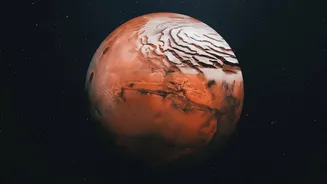
and the other is the Red Planet—a world that lost its atmosphere and surface water, becoming the frozen desert we see today. For decades, scientists have debated why these two neighbours took such different evolutionary paths. The answer, it turns out, may lie in how they were assembled from the very beginning.
Two Recipes for a Planet
Planetary scientists have long considered two main ways planets can grow: through violent collisions between large, kilometre-sized rocks called 'plenetesimals', or by a gentler process of sweeping up pebble-sized dust, known as 'pebble accretion'. For a long time, it was debated which method was dominant. Now, a study from the University of Copenhagen suggests the answer is a hybrid of both, but the recipe was dramatically different for Earth and Mars. “The most surprising result was that Earth and Mars appear to have formed in different ways,” said Professor Anders Johansen, who co-led the study.
Earth's Building Blocks
By analysing the chemical composition of Earth's crust and mantle and running advanced computer models, the researchers determined our planet's formation story. Their findings indicate that at least 75 percent of Earth's mass came from two large 'protoplanets' that grew primarily by collecting vast amounts of pebbles. These protoplanets, which are planetary embryos ranging from moon-sized to Mars-sized, acted like cosmic vacuum cleaners. The remaining 25 percent of Earth's mass was added through collisions with larger planetesimals. This pebble-dominant formation allowed Earth to grow large and gather the ingredients, like water and other volatile compounds, necessary for life.
Mars: A Different Path Taken
The story for Mars is almost the complete opposite. According to the study's models, roughly three-quarters of the Red Planet's mass was built from the violent collisions of planetesimals. Pebble accretion played a much smaller role, contributing only about 27% of its final mass. This reliance on a different building method may explain Mars' smaller size. It is essentially a 'stranded planetary embryo' that never grew large enough. Its rapid, collision-based formation likely meant it couldn't hold onto a thick atmosphere or large amounts of water as effectively as the slowly-and-steadily built Earth. Earlier research supports this idea of a very rapid formation for Mars, suggesting its core and crust were in place less than 20 million years after the solar system began to form.
Why It Matters for Alien Worlds
This new understanding does more than just solve a local mystery; it has profound implications for how we search for life elsewhere in the universe. The study suggests that the path a planet takes during its formation is a critical factor in determining its ultimate habitability. By analysing the 'chemical fingerprints' left by volatile elements, scientists can get clues about how a planet was made. This method provides a more direct way of understanding a planet's history than other approaches and could one day be applied to exoplanets orbiting other stars. Knowing a planet's construction history—whether it was built from pebbles or planetesimals—could help astronomers prioritise which distant worlds are the most likely candidates to harbour life.