

A Panoramic Window on the Universe
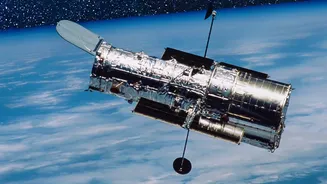
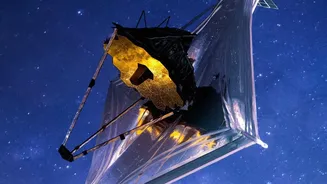
Imagine trying to understand a sprawling forest by looking through a drinking straw. That's been a challenge for telescopes like Hubble, which provide incredibly detailed but narrow views. The Nancy Grace Roman Space Telescope changes the game entirely.
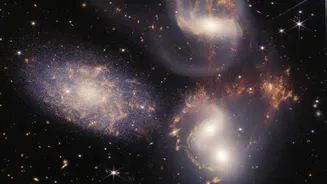
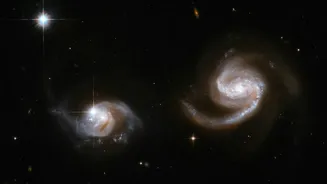
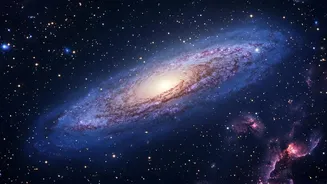
Its Wide Field Instrument allows it to see an area of the sky 100 times larger than Hubble can in a single snapshot, all with the same stunning resolution. This capability is the driving force behind its large-scale surveys. Instead of observing one galaxy, Roman can capture millions. This leap from a zoom lens to a panoramic camera will allow astronomers to map the universe's structure and evolution on an unprecedented scale, creating vast cosmic charts that will serve as a resource for decades to come.
Chasing the Ghost: The Hunt for Dark Energy
One of the biggest puzzles in modern physics is dark energy, the mysterious force causing the universe's expansion to accelerate. To study it, you need to observe how millions of galaxies have moved and grown over cosmic time. This is where Roman's High Latitude Wide Area Survey comes in. By imaging billions of galaxies and detecting thousands of distant exploding stars, called Type Ia supernovae, Roman will create a 3D map of the cosmos across billions of years. This map will allow scientists to measure the effects of dark energy with far greater precision, testing whether it's a constant force or something that has changed over time. It's like reconstructing the universe's history to understand the engine that drives its future.
A Galactic Census of New Worlds
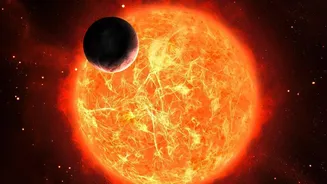
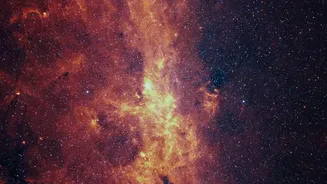
While famous for its cosmic scope, Roman is also a revolutionary planet hunter. Its Galactic Bulge Time Domain Survey will stare at the dense star fields at the center of our Milky Way, monitoring hundreds of millions of stars. It will primarily use a clever technique called gravitational microlensing. This occurs when a star or planet passes in front of a more distant star, and its gravity briefly acts like a magnifying glass, causing the background star's light to brighten. Roman's sensitivity from space will allow it to detect the tiny, brief flickers caused by planets, including those with masses as low as Mars and those that roam freely without a host star. It’s expected to discover thousands of new exoplanets this way, providing a statistical census of worlds in the colder, more distant regions of planetary systems—a population that other methods often miss.
Preparing for a Tsunami of Data
With great power comes a great deal of data—a true cosmic tsunami. The sheer volume of information Roman will generate is so immense that astronomers can't simply wait for it to arrive. Teams around the world are actively preparing right now. They are developing new algorithms and artificial intelligence tools to sift through the data and identify important signals, like the faint brightening of a microlensing event or the signature of a distant supernova. Scientists are running complex simulations to anticipate what the telescope will see, which helps them fine-tune their analysis pipelines and infrastructure before the real observations begin. This preparatory work is essential to ensure that when Roman opens its wide eyes on the sky, the scientific community is ready to handle the flood of discoveries and turn its data into a new understanding of the universe.