


That silky, rich bar of chocolate you love starts its life in a surprisingly humble way: as a cluster of beans inside a colourful pod. The journey from a tropical tree to a decadent treat is a fascinating story of transformation, blending ancient farming
methods with modern culinary science.
The Food of the Gods
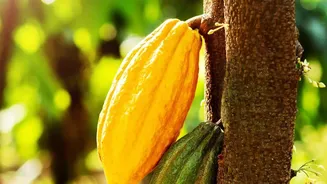
All chocolate originates from the Theobroma cacao tree, whose name translates from Greek as 'food of the gods'. These small evergreen trees thrive in the warm, humid climates near the equator, often growing under the protective canopy of taller plants like banana trees. The tree produces large, pod-like fruits that grow directly from its trunk and older branches. These pods, which ripen in shades of yellow, red, and purple, each contain 20 to 60 seeds—the cocoa beans—cushioned in a sweet, white pulp. Though a mature tree can produce thousands of flowers a year, only a small fraction will become fruit, making each pod precious.
Harvesting and Fermentation
Harvesting is a manual process. Ripe pods are carefully cut from the trees and opened to extract the beans and their surrounding pulp. This mixture is then fermented, a crucial step that transforms the beans' flavour. For several days, the beans are gathered in piles or boxes, often covered with banana leaves. Naturally occurring yeasts and bacteria break down the sugary pulp, generating heat that kills the bean's germ and reduces its initial bitterness. This process, which can last from three to seven days, is what begins to develop the complex flavour precursors that we associate with chocolate.
Drying and Roasting
After fermentation, the beans contain a lot of moisture and must be dried to prevent mould. They are spread out on trays and often sun-dried for five to ten days, a process that further develops their flavour. Once dried, the beans are shipped to chocolate makers around the world. At the factory, the first step is roasting. Much like coffee beans, cocoa beans are roasted to bring out their characteristic aroma and taste. The temperature and duration of the roast are carefully controlled to achieve a specific flavour profile, whether it's fruity, nutty, or deeply earthy.
From Nibs to Liquor
Once roasted, the beans are cracked, and their thin outer shells are removed in a process called winnowing. This leaves behind the broken pieces of the inner bean, known as cocoa nibs. These nibs are the heart of the chocolate. They are then ground into a thick, dark paste called chocolate liquor or cocoa mass. Despite its name, chocolate liquor contains no alcohol; it is simply pure, unadulterated liquid chocolate. At this stage, the path can diverge. The liquor can be pressed to separate it into cocoa butter (the fat) and cocoa solids, which are then pulverised to make cocoa powder.
The Final Polish: Conching and Tempering
To create a chocolate bar, the chocolate liquor is mixed with other ingredients like sugar, more cocoa butter, and, for milk chocolate, milk powder. The mixture then goes through conching, a process of continuous mixing, grinding, and aerating that can last for hours or even days. Conching is what gives chocolate its signature smooth, velvety texture by breaking down particles and removing any remaining acidic notes. The final step is tempering, where the chocolate is carefully heated and cooled to precise temperatures. This stabilises the cocoa butter crystals, ensuring the finished bar has a glossy shine and a satisfying snap when broken.