








First, What Is Agentic AI?
You’ve likely heard of generative AI like chatbots, which are great at analyzing data and creating content. Agentic AI is the next step. Think of it as the difference between a calculator and an autopilot. A calculator assists you, but an autopilot makes
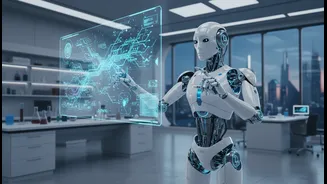
and executes decisions on its own. Agentic AI systems are designed to be autonomous; they can understand a goal, break it down into steps, make a plan, and then take action in the digital or physical world to achieve it. Instead of just responding to a prompt, these agents can reason, adapt to new information, and work towards complex objectives with minimal human intervention. This is a profound shift from AI that helps you work to AI that works for you.
The Stanford Breakthrough: From Code to Chemistry
Recent projects from Stanford University highlight this leap. One notable example is Biomni, a general-purpose biomedical AI agent developed by a cross-disciplinary team. Described as a virtual AI biologist, Biomni can analyze massive amounts of medical data, identify patterns humans might miss, and even design experiments. It integrates large language models with over 150 specialized bioinformatics tools and dozens of databases. Another Stanford project, the 'Virtual Lab', assembles teams of AI agents, each acting as a specialist in fields like immunology or computational biology. These agents collaborate, debate, and even critique each other to solve complex problems, such as designing a more effective vaccine for SARS-CoV-2, a task they accomplished in days. These are not just software programs; they are systems designed to mimic the collaborative and critical thinking process of a human research team.
Beyond the Digital: AI in the Physical World
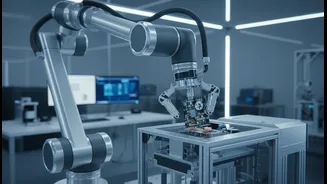
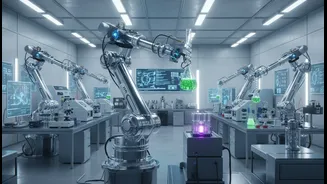
While virtual labs show AI's reasoning power, other Stanford projects demonstrate its growing physical capabilities. The Mobile ALOHA project developed a low-cost, mobile robot capable of learning complex, bimanual tasks through human demonstration. After being guided through an action like sautéing shrimp or cleaning a spill about 50 times, the robot can then perform the task autonomously. This is achieved through imitation learning, where the AI learns by observing, much like a human apprentice. While Mobile ALOHA was initially demonstrated on household chores, the underlying technology—combining mobility with dexterous manipulation—is exactly what's needed for automating physical work in laboratories, from handling samples to operating complex machinery. It represents a crucial step toward creating autonomous 'lab-pilot' systems.
The Promise of Accelerated Discovery
The implications for science and industry are enormous. By automating tedious and repetitive lab work, AI agents can free up human scientists to focus on higher-level thinking and creative problem-solving. Autonomous systems can run experiments 24/7, analyze results in minutes instead of weeks, and detect patterns across vast datasets that are beyond human capacity. This could dramatically accelerate the pace of discovery in fields like medicine, materials science, and clean energy. Companies are already developing AI agents to help labs digitize old paper protocols and automate workflows, promising to cut manual work and implementation costs significantly. The goal is to move from simply digitizing lab processes to creating truly autonomous operations that can optimize themselves.
The Challenges and the Road Ahead
Despite the excitement, the transition to fully autonomous labs is just beginning. These AI systems are still developing, and there are significant hurdles. Ensuring the reliability and safety of autonomous actions in a sensitive lab environment is a major concern. The high cost and complexity of implementation can be a barrier, and there's a need for robust human oversight to define research goals and validate results. Furthermore, the quality of an AI agent's work depends entirely on the data it's trained on, raising issues of potential bias and the need for transparent, reproducible methods. The ultimate vision is not to replace human scientists, but to augment their capabilities, creating a partnership where AI acts as a powerful collaborator in the quest for knowledge.