


A Galactic Mystery
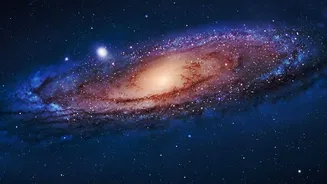
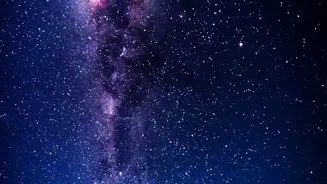
Imagine our sprawling spiral galaxy, a bustling city of stars, gas, and dust, being knocked over. That's the astonishing picture painted by recent astronomical research. For years, scientists have puzzled over a strange feature of our galaxy: the stellar
halo. This is a vast, sparse cloud of ancient stars that surrounds the main galactic disc. While stars in the disc, like our Sun, orbit the galactic center at a brisk 220 kilometers per second, the stars in the halo barely seem to move, rotating at a much slower speed. This discrepancy has been a long-standing mystery. Now, astronomers from Durham University believe they have the answer, and it involves a cataclysmic event from the Milky Way's youth.
The Prime Suspect: Gaia-Sausage-Enceladus
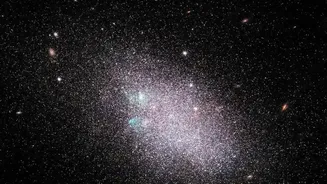
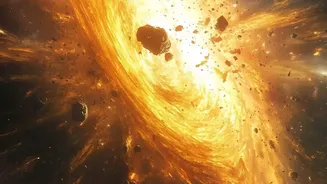
The culprit has a memorable name: Gaia-Sausage-Enceladus (GSE). This was a dwarf galaxy that collided head-on with a young Milky Way around 10 to 11 billion years ago. The name comes from the European Space Agency's Gaia mission, which first uncovered evidence of this merger in 2018, and the peculiar, sausage-shaped orbits of the intruder's stars after the crash. Though classified as a dwarf galaxy, GSE was a heavyweight, containing gas, dark matter, and stars with a mass over 10 billion times that of our Sun. It was the last major merger in our galaxy's history and an event that fundamentally reshaped it.
Flipping the Evidence
To connect this ancient collision to the slow-moving halo, researchers turned to powerful supercomputer simulations. They modeled the evolution of galaxies similar to our own and found a recurring pattern: galaxies that experienced a massive, head-on collision like the one with GSE almost always had their main disc flipped by more than 90 degrees. This violent reorientation, which would have taken hundreds of millions of years, provides a compelling explanation for the halo's strange behavior. The force of the impact would have thrown stars from both galaxies into new, chaotic orbits, creating the slowly rotating halo we see today. The collision effectively rewired the entire galaxy, creating the central bulge and scattering stars everywhere.
Our Place in a Reshaped Galaxy
This discovery does more than just solve a cosmic puzzle; it reframes our entire understanding of the Milky Way's history. The galaxy we call home is not a serene, undisturbed island in space but a product of a violent and dynamic past. The collision with GSE was a defining moment that triggered a burst of star formation and set the stage for the galaxy's later evolution, including the formation of the thinner disc where our solar system resides. If the entire galaxy was reoriented, it means that even our Sun's path through the cosmos today is different from what it might have been billions of years ago. This new insight helps astronomers piece together the complex story of how large galaxies like ours are built over cosmic time—often through brutal, cannibalistic mergers.