



What Exactly Is a 'Fire Rainbow'?
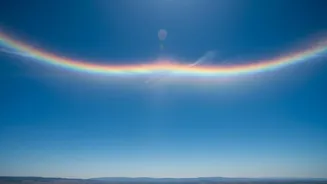
Despite its dramatic name, a 'fire rainbow' has nothing to do with fire and isn't a rainbow in the traditional sense. The proper scientific term is a circumhorizontal arc. The name comes from the fact that it appears as a large, colourful arc that runs
parallel to the horizon. Unlike a typical rainbow that forms an arch across the sky after rainfall, a circumhorizontal arc is an optical phenomenon that belongs to a family of ice halos. These are created by the interaction of light with ice crystals suspended high in the atmosphere, not with liquid water droplets. The name 'fire rainbow' comes from its flame-like appearance and brilliant pastel colours that seem to set a cloud ablaze.
The Science: A Symphony of Ice and Light
The magic behind a fire rainbow lies in the precise interaction between sunlight and tiny ice crystals. The phenomenon occurs in high-altitude cirrus or cirrostratus clouds, which are thin, wispy clouds found where temperatures are extremely low. These clouds are composed of millions of plate-shaped, hexagonal (six-sided) ice crystals. For a fire rainbow to form, these flat crystals must be oriented horizontally, like tiny plates floating in the air. When sunlight enters through a vertical side face of one of these crystals, it is refracted—or bent—and then exits through the bottom horizontal face. This 90-degree bend acts like a prism, splitting the white sunlight into its component spectral colours, creating the vibrant display we see.
The Perfect, Rare Conditions
Seeing a circumhorizontal arc is a rare treat because it requires a perfect alignment of several specific conditions. Firstly, the sun must be very high in the sky, at an elevation of 58 degrees or greater above the horizon. This is a key reason why the phenomenon is more common in mid-latitudes and is impossible to see at latitudes above 55 degrees North or below 55 degrees South. For example, a city like Los Angeles has many more hours per year where the sun is high enough compared to London, making sightings there more likely. Secondly, there must be high-altitude cirrus clouds present. Finally, the ice crystals within those clouds must have the right plate-like shape and be aligned horizontally to properly refract the light. If any of these conditions are not met, the arc will not form.
NASA Captures the Phenomenon
NASA's Astronomy Picture of the Day (APOD) recently featured a striking image of a circumhorizontal arc over West Virginia, bringing this beautiful phenomenon back into the public eye. The image, taken in 2021 but highlighted on August 2, 2026, perfectly showcases wispy cirrus fibratus clouds acting as what NASA describes as 'little floating prisms'. Such images are not just beautiful; they serve as excellent real-world examples that reinforce the scientific explanation. They illustrate how millions of tiny, unseen ice crystals working in concert can create a massive, colourful spectacle that can span hundreds of miles across the horizon. While often appearing in fragments due to patchy clouds, a full arc is a breathtaking sight.