




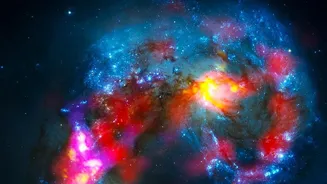
A Picture of Cosmic Deception
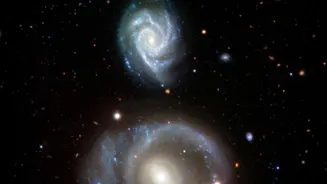
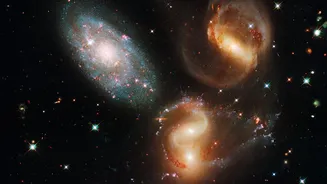
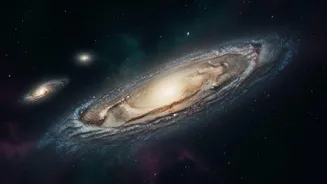
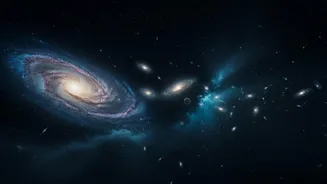
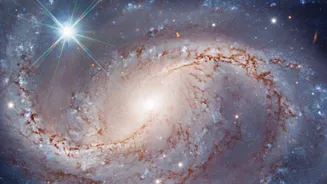
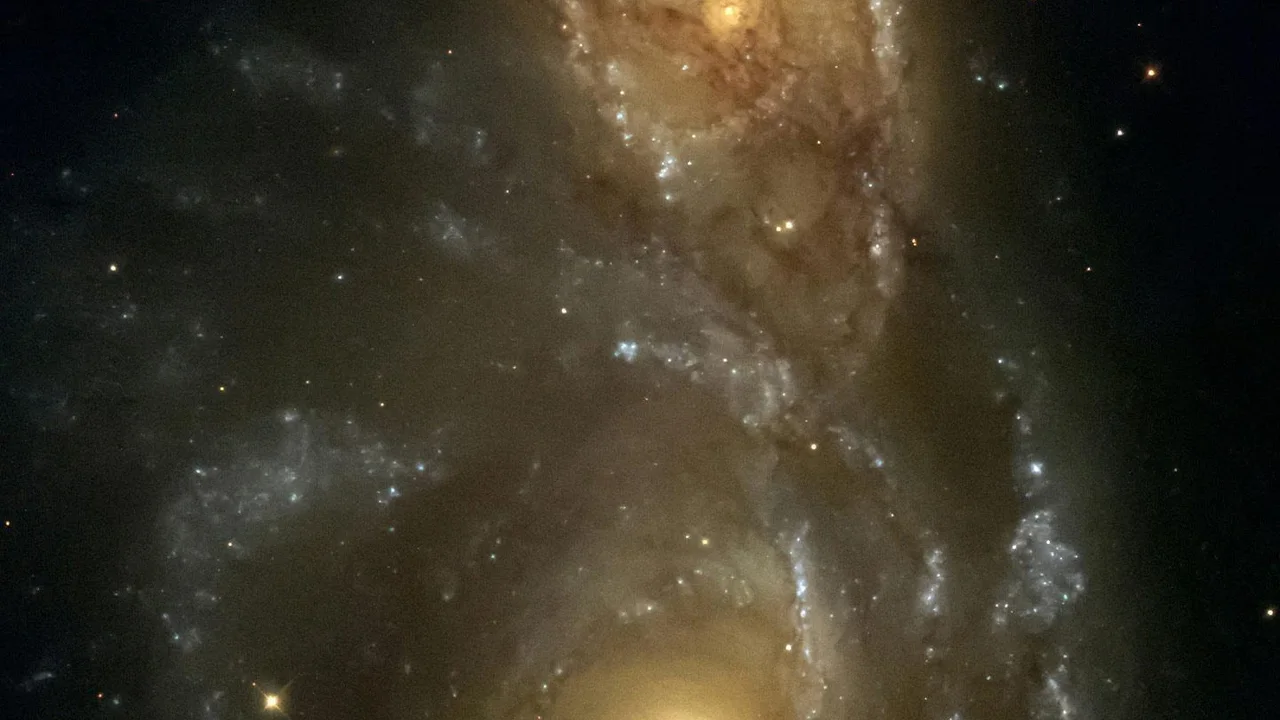
When we gaze upon a deep-field image from the Hubble or James Webb Space Telescope, we see a tapestry of light against the blackness of space. It's filled with majestic spirals, glowing ellipticals, and what often appear to be pairs or small groups of galaxies
interacting. Some look so close you could imagine them swinging past one another. These images are captivating because they seem to show intimate relationships across the cosmos. But for astronomers, the initial view is just the beginning of the story. They see a beautiful puzzle and ask a crucial question: are those galaxies truly companions, or are they strangers passing in the night, separated by unimaginable distances?
The Cosmic Line of Sight
The secret lies in the concept of a chance alignment, or a line-of-sight coincidence. It’s a simple trick of perspective played on a galactic scale. Think of it like seeing two streetlights down a long road at night; they might appear to be right next to each other, but one could be a block away while the other is a mile distant. From our viewpoint on Earth, two galaxies can appear side-by-side in our patch of sky while being separated by hundreds of millions of light-years. They aren't interacting at all; they just happen to fall along the same line of sight from our telescope. Distinguishing these optical pairs from true, gravitationally bound pairs is a fundamental task in astronomy.
How Astronomers Measure the Void
So, how do scientists tell the difference? The primary tool is measuring a galaxy's redshift. Thanks to the expansion of the universe, almost every galaxy is moving away from us. As a galaxy recedes, the light waves traveling from it get stretched out, shifting them toward the red end of the spectrum. This phenomenon is called cosmological redshift. The crucial part of Hubble's Law is that the farther away a galaxy is, the faster it is moving away from us and the more its light is redshifted. By analyzing the light from each galaxy in an apparent pair using a technique called spectroscopy, astronomers can measure their individual redshifts and, therefore, their distances.
Solving the 'Three-Pair' Puzzle
Applying this tool to an image that appears to show three pairs of galaxies can yield surprising results. Astronomers might find that one galaxy in a pair has a very small redshift, indicating it's relatively close—say, 70 million light-years away. But its apparent partner could have a massive redshift, placing it over a billion light-years away. In this scenario, they are not a pair at all. One is a foreground object, and the other is a vastly more distant background galaxy. Of the six galaxies in the hypothetical 'three pairs' image, scientists may find that only one pair is a true interacting duo, while the other four galaxies are all at completely different distances, their pairings a complete coincidence.
Why These Illusions Still Matter
Discovering a pairing is just an illusion isn't a disappointment for astronomers. These chance alignments are scientifically valuable in their own right. Studying the light from a distant background galaxy as it passes through a closer foreground galaxy can reveal details about the foreground galaxy's dusty spiral arms, which appear in silhouette. In some cases, the gravity of a massive foreground galaxy can act as a natural telescope, a phenomenon known as gravitational lensing. It bends and magnifies the light from a much more distant object directly behind it, allowing us to see details of the early universe that would otherwise be invisible. These cosmic coincidences provide unique opportunities to probe the universe's structure and contents.