






The Fiery Heart of Our Planet
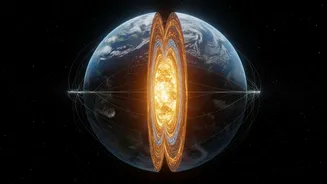
To understand this discovery, we first have to journey to the center of the Earth—metaphorically, of course. Our planet is structured in layers. At its heart lies a solid inner core, surrounded by a turbulent, liquid outer core composed mainly of molten
iron and nickel. This superheated liquid metal is constantly churning and swirling, some 2,200 kilometres below the surface. This motion is not random; it's the engine that powers one of the most important systems for life on Earth.
Earth’s Protective Magnetic Shield
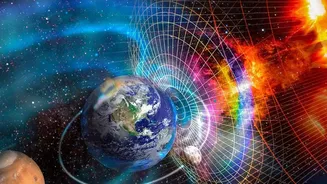
The movement of this electrically conductive liquid iron in the outer core acts like a massive dynamo, generating Earth's magnetic field. This field extends far out into space, forming a protective bubble called the magnetosphere. Without it, we would be defenceless against harmful solar radiation and charged particles from the sun, which could strip away our atmosphere. For years, scientific models based on magnetic field measurements suggested the core's flow was relatively stable, with a dominant westward drift.
An Unexpected U-Turn
Around 2010, something completely unexpected happened. A vast stream of molten iron deep beneath the Pacific Ocean, which had been flowing weakly westward, suddenly and rapidly reversed course and began moving eastward. This wasn't a wobble; it was a dramatic shift that challenged decades of assumptions about the core's behaviour. The headline-making "core-flow reversal" doesn't mean the entire core flipped, but rather that a significant, continent-sized portion of it changed its mind, and scientists are still working to understand why.
Eyes in the Sky Watching Deep Earth
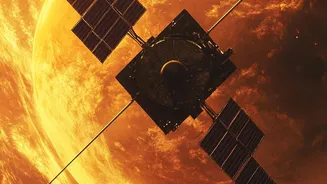
How can we possibly know what's happening thousands of kilometres beneath the ground? The answer lies in space. A constellation of highly sensitive satellites, most notably the European Space Agency's (ESA) Swarm mission, orbits our planet. Launched in 2013, these spacecraft carry magnetometers of exceptional precision. By flying in coordinated orbits, they can meticulously map Earth's magnetic field and, crucially, distinguish the faint magnetic signals originating from the core from all the other magnetic noise from the crust, oceans, and atmosphere. These satellites act like a planetary-scale MRI, allowing scientists to reconstruct the flow patterns of the liquid core by tracking tiny changes in the magnetic field over time.
What the Reversal Reveals
This discovery is profound because it shows that the processes deep within our planet can be far more dynamic and rapid than previously thought. The reversal event has been linked to other phenomena, like a sudden jolt in the magnetic field known as a geomagnetic jerk. Some scientists also hypothesize that the change is connected to shifts in the behaviour of the solid inner core that occurred around the same time. The latest data suggests the strong eastward flow has already begun to weaken since 2020, adding to the mystery. Scientists are now questioning whether this was a one-off event, part of a repeating cycle, or the beginning of a new stable pattern.