

India's Sentinel at L1
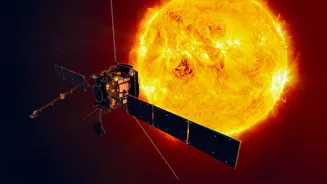
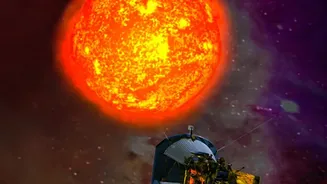
Launched by ISRO on September 2, 2023, Aditya-L1 is India's first dedicated space-based solar observatory. It is strategically positioned at the Sun-Earth Lagrange Point 1 (L1), about 1.5 million kilometres from Earth, giving it a continuous, uninterrupted
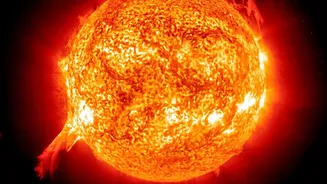
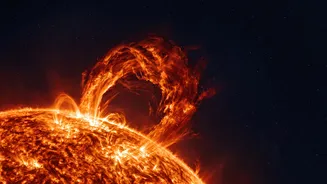
view of our star. From this vantage point, its seven advanced payloads monitor the Sun's atmosphere, from the photosphere and chromosphere to the outermost corona. One of its key instruments, the Visible Emission Line Coronagraph (VELC), is designed to study the dynamics and origins of Coronal Mass Ejections (CMEs), which are massive bursts of plasma and magnetic fields from the Sun. These observations are crucial for understanding the physics of the solar corona and its heating mechanism, a long-standing puzzle in solar science.
Europe's Artificial Eclipse
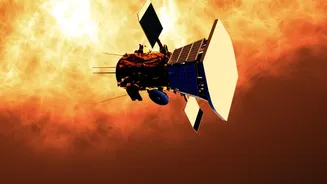
The European Space Agency's (ESA) Proba-3 mission is a technological marvel in its own right. Launched by an ISRO PSLV rocket in late 2024, it is the world's first precision formation-flying mission. Proba-3 consists of two separate spacecraft: an 'Occulter' and a 'Coronagraph'. Flying in a precise tandem about 150 metres apart, the Occulter satellite blocks the blinding light of the Sun's main disk, creating a near-perfect artificial eclipse for the Coronagraph satellite trailing behind. This innovative setup allows its ASPIICS instrument to capture incredibly detailed images of the Sun's faint inner corona, a region notoriously difficult to observe. This provides a unique perspective on the very birth of solar eruptions.
Two Views Are Better Than One
While each mission is powerful, their combined strength is revolutionary. The challenge with observing a CME from a single point, like Aditya-L1's position, is that it can be difficult to determine its exact direction and three-dimensional structure. An eruption that appears as a 'halo' could be heading directly for Earth or moving away. This is where Proba-3's complementary view becomes invaluable. By observing the same event from a different angle in its own orbit around Earth, Proba-3 provides the crucial second perspective needed for stereoscopic vision. Scientists can combine the imaging data from Proba-3's ASPIICS with the spectroscopic data from Aditya-L1's VELC, which measures the temperature and density of the erupting plasma. This fusion of data allows them to build a comprehensive 3D model of a CME as it leaves the Sun.
A New Era for Space Weather Prediction
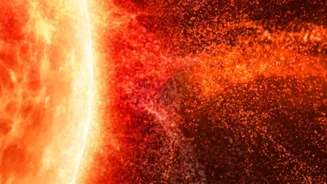
This joint study is about more than just fundamental science; it has profound practical implications. CMEs are the primary drivers of space weather, which can have significant effects here on Earth. When a powerful CME strikes our planet's magnetic field, it can induce geomagnetic storms capable of disrupting communication networks, damaging satellites, overloading power grids, and posing a risk to astronauts in orbit. For years, observing CMEs near the Sun to track their early evolution has been a major challenge. The combined power of Aditya-L1 and Proba-3 helps to solve this problem by providing detailed measurements of a CME's mass, density, and energy right after it erupts. This information is critical for improving the accuracy and lead time of space weather forecasts, giving us a better chance to mitigate the potential impacts of severe solar storms.