




What Exactly is a Galactic 'Flip'?
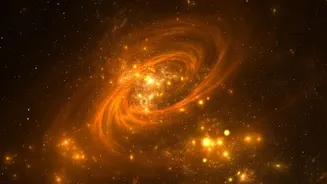
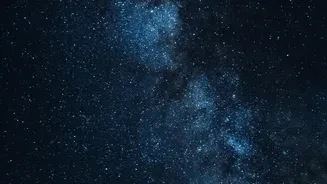
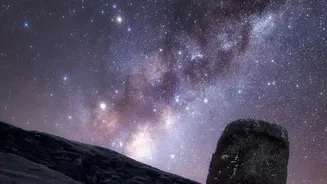
Imagine our galaxy not as a flat, spinning plate, but as one that has been tilted on its side over billions of years. The 'flip' refers to a dramatic reorientation of the Milky Way's main stellar disc by more than 90 degrees. This wasn't a sudden, jarring
event like flipping a coin. Instead, it was a gradual process, likely driven by immense gravitational forces from a galactic collision, that unfolded over one to two billion years. While the stars continued their orbits, the entire plane of the galaxy slowly and majestically shifted its position within its vast, surrounding halo of dark matter.
The Clue in the Slow-Moving Stars
The key evidence for this ancient flip comes from a long-standing cosmic mystery: the behaviour of the stellar halo. This is a sparse, spherical cloud of ancient stars that surrounds our galaxy's main disc. While the stars in the disc (including our Sun) zip around the galactic centre at high speed, data from the European Space Agency's Gaia mission revealed the stellar halo barely rotates at all. This puzzled astronomers for years. New supercomputer simulations provided an answer: galaxies that experience a major 'disc flip' in their history are far more likely to have these slow-moving stellar haloes.
A Collision of Cosmic Proportions
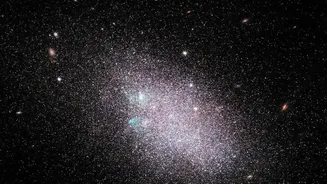
The prime suspect behind this galactic upheaval is a smaller galaxy known as Gaia-Sausage-Enceladus (or the Gaia Sausage). About 10 billion years ago, this dwarf galaxy slammed into our own in a massive, head-on collision. This wasn't a simple crash, but a gravitational dance of destruction where the smaller galaxy was torn apart and its stars were absorbed into the Milky Way. The simulations suggest it was the immense gravitational shock from this merger that initiated the long, slow process of flipping our galaxy's disc.
Not a Single Punch, but a Prolonged Dance
While the Gaia Sausage collision may have been the main trigger for the flip, the story of our galaxy's shape is one of continuous evolution, not a single event. The Milky Way is constantly interacting with satellite galaxies. The Sagittarius dwarf galaxy, for example, has passed through our galaxy's disc multiple times over the last six billion years. These repeated encounters act like a stone tossed in a pond, creating ripples and warps in the galactic disc that we can still observe today. These interactions also triggered major episodes of star formation, and it's even possible one such event led to the formation of our own Sun.
Why This Cosmic History Matters
Understanding that the Milky Way’s orientation changed gradually over billions of years gives us a more refined picture of how all large spiral galaxies are built. It suggests they grow not just through singular, cataclysmic mergers, but through a long and complex history of collisions, absorptions, and slow gravitational adjustments. This new evidence helps explain puzzling features of our galaxy, from its warped disc to its slowly rotating halo. It transforms our view from a static picture to a dynamic story of a galaxy constantly changing and evolving, a process that continues even today as the Milky Way slowly consumes its smaller neighbours.