





Why Technique is Everything
At first glance, Nordic walking looks simple. However, the specific technique is what transforms a simple walk into a low-impact, full-body workout that engages up to 90% of your muscles. Unlike hiking, where poles are primarily for stability, Nordic walking poles are active
tools for propulsion. Using them correctly increases your heart rate and calorie burn compared to regular walking, all without making you feel like you're working harder. This is because the effort is distributed across your entire body, reducing stress on joints in the hips, knees, and feet. But without the right form and equipment, you miss out on these benefits and can even introduce unnecessary strain or bad habits.
Finding Your Perfect Pole Length
The single most common mistake beginners make is choosing the wrong pole size. Poles that are too short can cause you to hunch over, while poles that are too long can strain your shoulders and make propulsion ineffective. There are two simple methods to find the right fit. The most common formula is to multiply your height in centimetres by 0.68. For example, a person who is 175 cm tall would look for poles around 119 cm (175 x 0.68 = 119). Another reliable method is to stand straight with your elbow bent at a 90-degree angle; your forearm should be parallel to the ground when holding the pole grip. If you're between sizes, beginners should generally opt for the shorter pole, as it's easier to learn with.
Mastering the Basic Technique
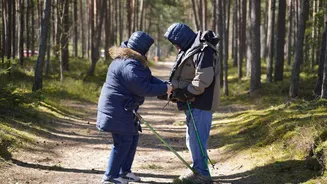
Proper Nordic walking follows the body's natural rhythm. The core principle is opposition: your right arm moves forward with your left leg, and your left arm moves forward with your right leg. Stand tall with a slight lean forward from your ankles, keeping your shoulders relaxed and your gaze ahead. The movement should originate from your shoulders, not your elbows, allowing for a long, smooth arm swing. Plant the pole tip angled backwards, roughly between your front and back foot. As you push off the pole, your arm should extend fully behind you. A key part of the technique is opening your hand at the end of the push, relying on the glove-like strap to maintain contact as your arm swings forward again. This creates a fluid, powerful motion that propels you forward.
Common Mistakes to Avoid
Many beginners inadvertently adopt habits that reduce the effectiveness of their walk. One major error is planting the poles too far in front of the body, which acts as a brake rather than a propeller and can strain your joints. Another is walking with bent elbows or keeping the arms tucked in, which limits the power of your upper body. Be mindful of your posture; avoid hunching your back and looking down at your feet. Some people also fall into a 'pacing' gait, moving the arm and leg on the same side together. If this happens, try letting the poles drag behind you for a moment while you walk naturally to reset your coordination.
Consistency Is More Important Than Speed
It's tempting to focus on how fast you can go, but the true benefits of Nordic walking come from maintaining good form over a consistent duration. Rushing often leads to sloppy technique, reducing muscle engagement and increasing the risk of strain. Instead, focus on establishing a steady rhythm where you can feel your core, back, and arm muscles working with each push. Starting with two to three sessions of 20-30 minutes per week is a great goal. As your technique becomes second nature, your pace and endurance will naturally increase. Remember, a smooth, powerful stride maintained for 30 minutes is far more beneficial than 15 minutes of frantic, incorrect movement. The goal is a comfortable, sustainable workout that builds fitness over time.