





A Planetary Puzzle
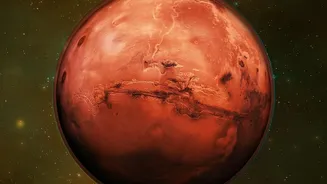
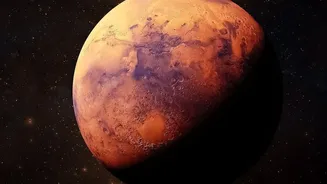
For decades, scientists have puzzled over the geological history of Mars. Unlike Earth, with its churning interior and shifting continents, Mars was thought to have a relatively straightforward past. The common theory was that an early, planet-wide magma
ocean cooled to form a simple, uniform crust of basaltic rock. While Earth's geology is defined by constant recycling through plate tectonics, Mars's 'stagnant lid' surface suggested a much quieter story. However, recent discoveries have begun to challenge this view, pointing to a more complex and evolved crust than previously imagined.
Listening to the Martian Heartbeat
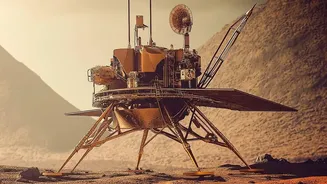
The latest and most compelling clue comes from beneath the Martian surface. Using seismic data collected by NASA's InSight lander, which listens for 'marsquakes' and meteorite impacts, researchers detected a mysterious boundary about 24 kilometers deep. By analysing how seismic waves travelled through the planet, a team from the University of Oxford realised this was not just a random anomaly. It marks a significant change in rock type, separating an upper, silica-rich crust from a denser, ultramafic layer below—one rich in iron and magnesium. This lower layer, estimated to be around 14 kilometers thick, is interpreted as a 'melt-depleted cumulate zone'.
The Great Magma Seperation
In simpler terms, scientists believe they have found the leftover remnants of a massive, ancient magma system. Imagine a huge, subterranean chamber of molten rock slowly cooling over millions of years. As it cooled, heavier, denser crystals would have formed and settled at the bottom, creating the ultramafic layer that InSight detected. Meanwhile, the remaining lighter, silica-rich liquid magma—the 'extracted' part—would have been squeezed upwards, potentially feeding volcanoes or forming other parts of the crust. This entire process, a vast plumbing system that reprocesses material through the entire thickness of the crust, is known as transcrustal magmatism.
A Process Once Thought Unique to Earth
What makes this discovery so significant is that transcrustal magmatism was, until now, thought to require plate tectonics. On Earth, these vast magma systems are associated with the creation of continents and volcanic chains, all driven by the engine of our planet's moving plates. Finding evidence of a similar system on Mars, a planet without plate tectonics, forces a major rethink. It suggests that rocky planets can develop complex, evolved crusts through other mechanisms. This discovery implies that the geological processes that can lead to habitable conditions—like the cycling of water and the formation of an atmosphere—might be more common across the cosmos than previously believed.
Rewriting Red Planet History
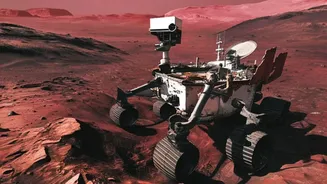
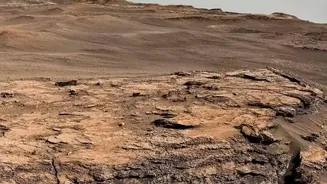
This hidden layer essentially acts as a geological tape recorder. It provides a physical record of magma being extracted and differentiated deep within Mars, a process that shaped the planet's surface and evolution over billions of years. The findings suggest that Mars once sustained enormous, interconnected magmatic systems, potentially stretching for thousands of kilometers across its northern hemisphere, rather than just hosting simple, isolated volcanoes. This not only explains some of the more evolved, silica-rich rocks seen on the surface by rovers like Perseverance, but also paints a picture of a much more geologically dynamic young Mars.