





Animal Flow: The Crab Reach
Animal Flow is a ground-based bodyweight practice that blends movements from disciplines like yoga and martial arts into a fluid sequence. The Crab Reach is a core move that improves mobility in the chest and shoulders while strengthening your entire
posterior chain. To perform it, sit on the floor with your knees bent and feet flat. Place your hands on the floor behind you with fingertips pointing away. Lift your hips slightly off the ground. From here, press through your feet, lift your hips high, and reach one arm up and over your head, following your hand with your eyes. The movement should be a smooth, controlled arc. Lower your hips back down and repeat on the other side, creating a rhythmic, dance-like flow between sides. It's fantastic for opening up the thoracic spine, which often gets tight from sitting.
Shadow Boxing with Light Weights
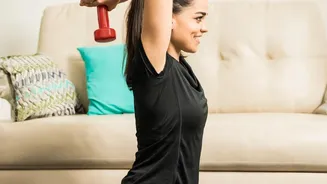
Shadow boxing is a classic training method for a reason: it builds upper-body endurance, coordination, and power. By adding very light dumbbells (0.5 to 1.5 kg is plenty) or even just holding your fists tightly, you add resistance that sculpts the shoulders, arms, and back. The key is rhythm. Put on some music with a strong beat and sync your punches to it. Start with basic combinations: jab, cross, hook, and uppercut. Focus on sharp, controlled movements rather than wild swinging. Stay light on your feet and engage your core, letting your torso rotate with each punch. This isn't about heavy lifting; it's about sustained, rhythmic movement that challenges your muscular endurance and elevates your heart rate, providing both a cardio and strength workout in one.
Battle Rope Alternating Waves
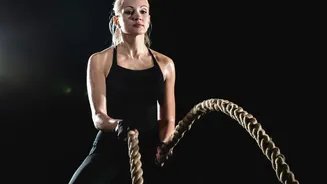
Described as “wind sprints for your arms,” battle ropes are an incredible tool for high-intensity, rhythmic training. The Alternating Wave is the foundational move and a potent upper-body conditioner. Stand with your feet shoulder-width apart, holding one end of the rope in each hand. Keeping a slight bend in your knees and elbows, rapidly raise and lower each arm in an alternating fashion to send waves down the length of the rope. Your goal is to create a consistent, powerful rhythm that you can sustain. This exercise torches calories while building explosive power and endurance in your shoulders, biceps, triceps, and back. The constant tension and fluid motion make it a perfect example of rhythmic strength training.
Kettlebell Flow Sequences
Kettlebells are uniquely suited for flowing, dynamic movements. The off-center weight challenges your stabilizer muscles and improves coordination. A simple but effective upper-body flow combines the Kettlebell Clean, Squat, and Press. Start with the kettlebell on the floor between your feet. Hike it back like an American football, then drive your hips forward to powerfully “clean” the bell to the rack position at your shoulder. From there, sink into a squat, and as you rise, press the kettlebell straight overhead. Bring it back down to the rack position and then to the floor to begin the next rep. The goal is to make the entire sequence one smooth, continuous motion, linking each part with rhythmic breathing and fluid transitions. This builds full-body power with a major emphasis on the shoulder, back, and arm.
Dancer Arm Circles and Pulses
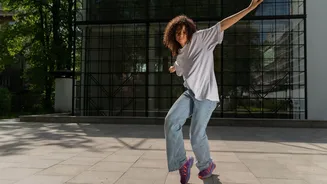
Dancers are known for their graceful yet powerful arms, achieved through exercises that focus on endurance and control. You can adopt these principles without any equipment. Stand with your feet shoulder-width apart and extend your arms out to the sides to form a 'T' shape. Keeping a slight bend in your elbows, begin making small, controlled circles with your arms. After 30 seconds of forward circles, reverse for 30 seconds. Then, turn your palms to face the ceiling and pulse your arms upward for another 30 seconds. These may seem simple, but holding your arms up for extended periods creates an intense isometric challenge for the shoulders and back muscles responsible for posture. The rhythmic circling and pulsing builds endurance and definition, creating that distinct “dancer arm” strength and tone.