


India's first solar observatory, Aditya-L1, is transforming our view of the Sun. Recent findings from the mission have challenged a long-held assumption, revealing that violent solar eruptions are not the neat, symmetrical bubbles we once imagined.
India's Unblinking Eye on the Sun
Launched
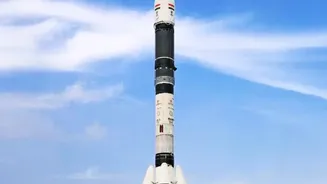
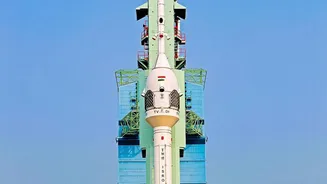
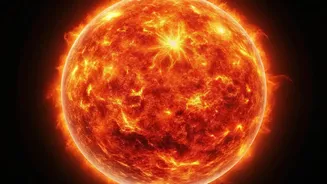
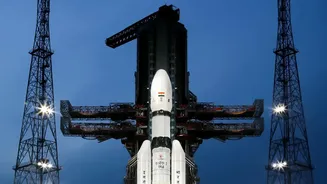
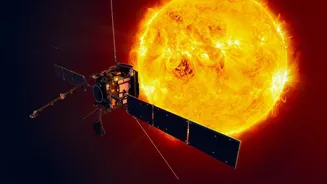
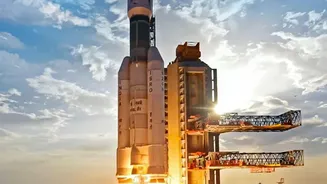
in September 2023, the Aditya-L1 spacecraft is a landmark achievement for the Indian Space Research Organisation (ISRO). Positioned 1.5 million kilometres from Earth at a unique gravitational balance point called Lagrange Point 1 (L1), the observatory has an uninterrupted view of our star. Its primary mission is to study the Sun’s outer atmosphere, the corona, and provide crucial data on solar phenomena that drive space weather. Among its seven advanced instruments, the Visible Emission Line Coronagraph (VELC) is its primary payload, designed specifically to study Coronal Mass Ejections (CMEs) in unprecedented detail. These are colossal eruptions of plasma and magnetic fields from the Sun that can have significant impacts here on Earth.
The Myth of the Symmetrical Bubble
For years, scientific models have often simplified CMEs, depicting them as uniformly expanding bubbles or clouds of plasma that swell symmetrically as they travel away from the Sun. While this was a useful approximation, scientists have long suspected the reality is far more complex. The true shape and structure of a CME are incredibly difficult to measure from a distance. Coronagraphs on past observatories could capture a two-dimensional image of a CME moving across the sky, but they couldn't measure the speed of the plasma moving directly towards or away from the observer. This limitation made it challenging to build a complete 3D picture of these events, forcing forecasters to rely on more simplified models. Understanding the true geometry is not just an academic exercise; it is critical for predicting how a solar storm will evolve on its journey through the solar system.
A New, Complex Picture Emerges
A recent study from scientists at the Indian Institute of Astrophysics (IIA) has provided a breakthrough. By combining data from Aditya-L1's VELC instrument with observations from NASA's Solar Dynamics Observatory (SDO), they reconstructed the 3D structure of a CME that occurred on August 5, 2024. VELC's unique spectroscopic capabilities allowed researchers to measure the velocity of the plasma along our line of sight. It detected plasma moving both towards and away from the observer simultaneously, a pattern inconsistent with a simple, uniform bubble. The analysis, published in The Astrophysical Journal Letters, revealed that the CME was expanding asymmetrically, with an inclined axis and uneven lateral growth. A 3D model based on a symmetrical bubble failed to reproduce what VELC saw, but a model incorporating this lopsided expansion was a near-perfect match.
Why an Irregular Shape Matters
This discovery has profound implications for space weather forecasting. The shape and structure of a CME influence its speed and trajectory as it travels through space. An asymmetrical eruption can interact with the surrounding solar wind differently, potentially altering its path or causing it to arrive at Earth sooner or later than predicted. More importantly, the impact of a CME on Earth’s magnetic field depends heavily on its orientation and the structure of its internal magnetic field. A lopsided CME could deliver a more concentrated or unpredictable blow to our planet's magnetosphere. This can pose a greater risk to our critical infrastructure, including communication satellites, GPS navigation, and electrical power grids. By providing a more accurate picture of how CMEs behave in their earliest stages, Aditya-L1 is helping to build better models that can improve our ability to protect this vital technology.