



Our galaxy is filled with violent and beautiful events, but some cosmic puzzles are harder to solve than others. Astronomers have been stumped by a source pumping out extreme energy, and they now have a new, though tentative, theory.
A Cosmic Mystery
Deep within the Milky
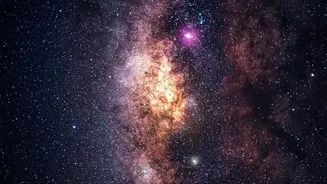
Way lies a perplexing object known as HESS J1813-178. It's a source of incredibly powerful gamma rays, the most energetic form of light. What makes it particularly interesting is its association with a young, bright supernova remnant — the expanding shell of debris left over after a massive star explodes. Normally, a young remnant can explain some high-energy emissions, but HESS J1813-178 is far too bright. The energy it's blasting out is more than a simple supernova remnant can account for, suggesting something else is powering it from within. For years, the exact nature of this engine remained a mystery, as it was not immediately visible in other wavelengths like radio or standard X-rays.
Searching for a Power Source
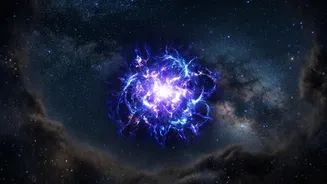
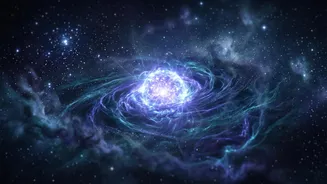
The usual suspect for this kind of cosmic power plant is a pulsar. A pulsar is a super-dense, rapidly spinning core of a dead star, which acts like a cosmic lighthouse, sweeping beams of radiation through space. Often, these pulsars create a 'pulsar wind nebula' (PWN) — a cloud of highly energetic particles blown outwards by the pulsar's intense magnetic fields and fast rotation. This nebula can glow brightly in high-energy wavelengths. So, the theory was simple: there must be a pulsar at the heart of HESS J1813-178, powering the whole system. The only problem was that for a long time, no one could find it. The immense power was there, but the engine driving it seemed to be invisible.
A Tentative 'Smoking Gun'
Recent, more detailed analysis offers a compelling, though still tentative, explanation. Researchers now believe they have identified the powerhouse: a pulsar designated PSR J1813-1749. This isn't just any pulsar; it's one of the most energetic ever discovered in our galaxy. The new explanation posits that this powerful pulsar is indeed creating a vast and complex pulsar wind nebula. The theory suggests the gamma rays we see are produced by electrons and positrons accelerated to nearly the speed of light within this nebula, which have then escaped the main shell and are interacting with surrounding radiation fields. This 'halo' of escaped particles would account for the extended and extremely bright gamma-ray emission that has puzzled astronomers for so long.
Why the Explanation is Still 'Tentative'
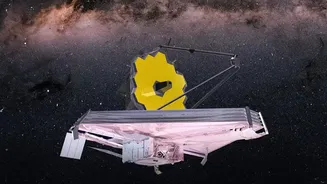
Science is a process of building evidence, and while the pulsar wind nebula theory is the strongest contender, it's not yet considered a closed case. The term 'tentative' is used because while the model of a powerful pulsar and its escaping particle halo fits the observational data well, there are still complexities in the region that are not fully understood. For instance, the exact mechanics of how particles escape the nebula and the precise structure of the magnetic fields that contain them are still areas of active research. Confirming the theory beyond a doubt will require even more detailed observations from next-generation telescopes. These future instruments will be able to map the region with greater sensitivity, potentially revealing the finer details of the particle halo and solidifying this explanation.
What This Teaches Us About the Galaxy
Solving the puzzle of HESS J1813-178 isn't just about one strange object. It provides a crucial piece of the puzzle in understanding how the most extreme objects in our galaxy work. These environments are natural laboratories for physics that we could never replicate on Earth, involving incredible energies, densities, and magnetic fields. By studying systems like this, where a young supernova remnant is powered by an energetic pulsar, astronomers learn more about how massive stars die, how heavy elements are distributed through space, and how cosmic rays — high-energy particles that zip through the galaxy — are accelerated. Each mystery solved, even tentatively, helps us paint a more complete and dynamic picture of our own galactic home.