




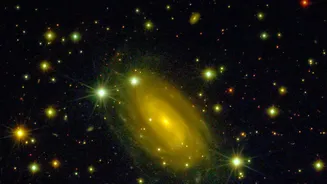
Andromeda: The Perfect Cosmic Laboratory
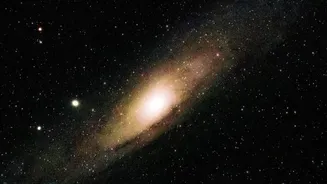
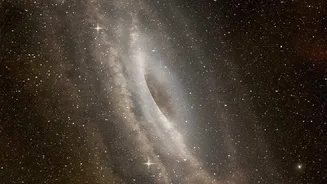
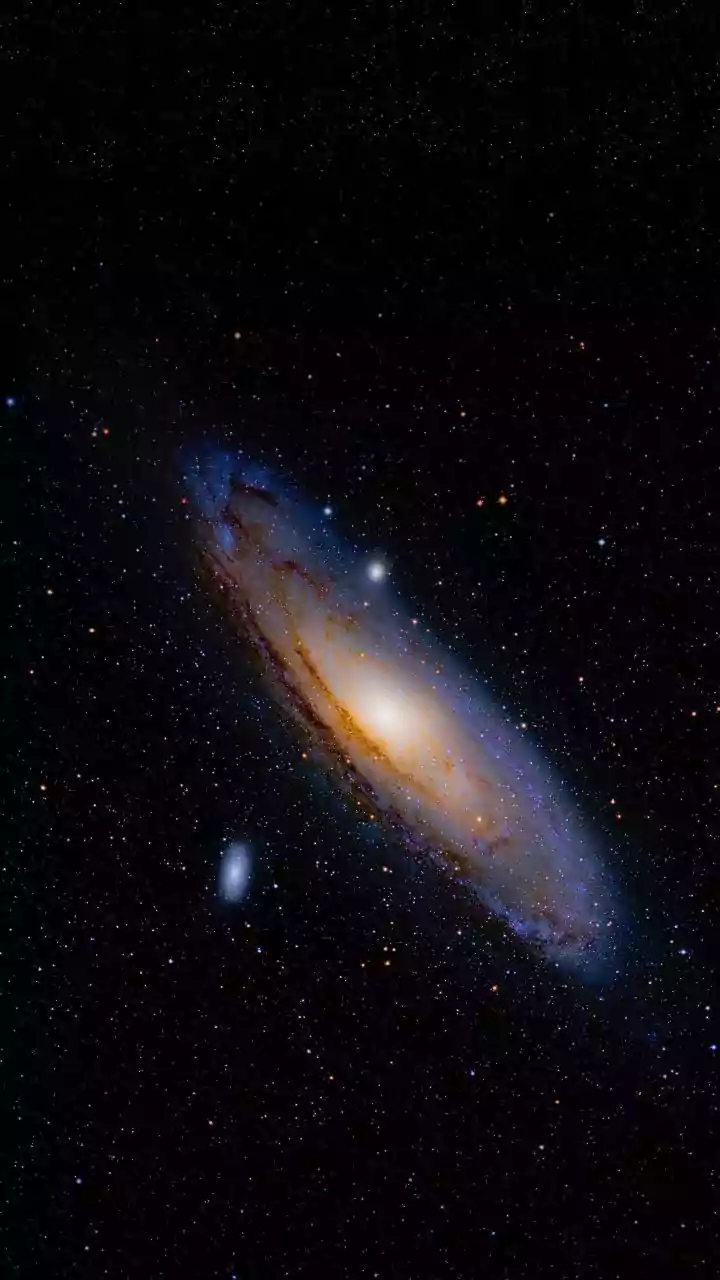
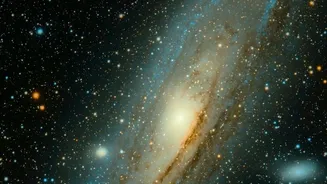
At 2.5 million light-years away, the Andromeda galaxy is our closest major galactic neighbor. It’s a spiral galaxy similar in size to our own Milky Way, making it an ideal subject for comparison. Crucially, its proximity and our viewing angle give us
a stunning, top-down perspective that we can't get of our own galaxy from within. This unique vantage point allows telescopes like Hubble to act as cosmic historians, studying another galaxy's lifecycle in extraordinary detail to better understand the story of galaxies like ours.
Hubble's Unprecedented Star Census
To understand Andromeda's history, astronomers conducted a massive survey called the Panchromatic Hubble Andromeda Treasury (PHAT). This ambitious project, combined with a southern extension, mapped about two-thirds of the galaxy's sprawling disk. Using multiple filters from ultraviolet to near-infrared light, Hubble meticulously cataloged the light and color of approximately 200 million individual stars. This created an unprecedentedly detailed 'fossil record' of the galaxy. As one astronomer noted, only Hubble has the sharp resolution to resolve individual stars on such a grand scale in Andromeda.
Reading the Colors of Time
The key to reading this stellar history lies in color. Massive, hot stars burn brightly with a blueish light, but they live fast and die young. Smaller, cooler stars glow with a redder hue and can live for billions of years. By analyzing the ratio of blue to red stars across different regions, scientists can determine when and where star formation has been most active. The PHAT survey essentially divided the galaxy into thousands of smaller neighborhoods, each about 300 light-years across, and built a star-formation timeline for each one, creating a comprehensive map of Andromeda's past activity.
A Universe Winding Down
The data revealed a clear and steady trend: star formation in Andromeda is in a long, slow decline. Astronomers found that about 2 billion years ago, the galaxy experienced a major burst of star-making, likely triggered by an interaction with another galaxy. But over the last 500 million years, the rate has been consistently dropping. Around 500 million years ago, Andromeda was creating stars at a rate of about one solar mass per year, similar to our Milky Way's current output. That has since fallen dramatically, with a particularly sharp drop in the last 40 million years to just a fraction of its former glory.
What It Means for the Cosmos
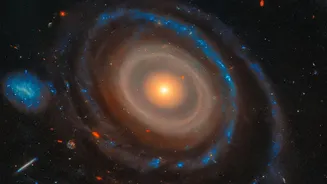
This isn't a case of Andromeda running out of gas; rather, the galaxy seems to be settling into a more quiet phase of its life after a boisterous youth. Much of the recent slowdown is linked to the fading activity in a prominent star-forming ring located about 32,000 light-years from the galaxy's center. This phenomenon is not unique to Andromeda. The star formation rate across the entire universe peaked around 11 billion years ago and has been declining ever since. By studying Andromeda in such fine detail, we are watching a process that reflects the broader evolution of the cosmos—a universe that is slowly maturing and becoming less active.