



A New Cosmic Mystery
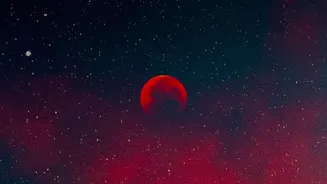
Scientists using NASA's James Webb Space Telescope (JWST) have identified an object that defies easy categorisation. Spotted in the very early universe, just a few hundred million years after the Big Bang, the object appears as an intensely bright, red dot.
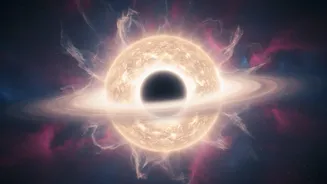
It has the visual characteristics of a huge star, perhaps as large as our entire solar system, but it radiates an amount of energy that is physically impossible for a star to produce through nuclear fusion. This incredible energy output is more typical of a supermassive black hole actively feeding on surrounding matter. This has led researchers to a startling hypothesis: they may have discovered an entirely new class of celestial object, which they are calling a 'black hole star'.
How a Black Hole 'Shines'
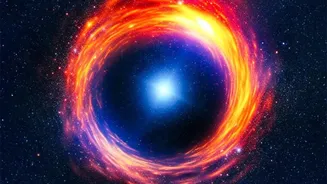
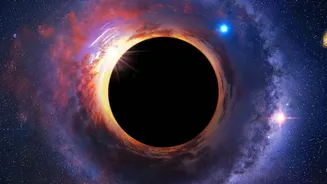
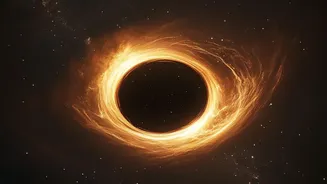
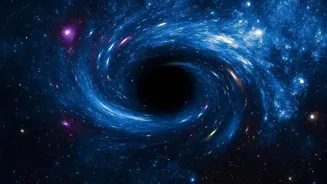
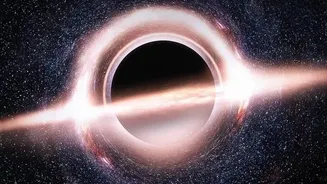
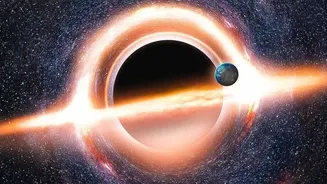
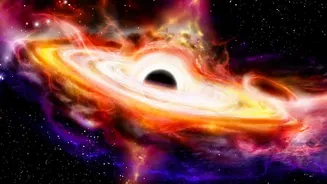
The idea of a black hole creating light seems contradictory. After all, black holes are famous for their gravitational pull, which is so strong that not even light can escape. But the power source isn't the black hole itself, but the process of it feeding. As a black hole pulls in enormous amounts of gas and dust, the material forms a swirling, superheated structure around it called an accretion disk. The friction and intense gravitational forces within this disk generate immense amounts of energy, causing it to blaze brightly and act as the engine for the object. In this new object, the central black hole is thought to be cocooned within a vast, dense envelope of gas. This gas cloud is what observers see, glowing like a giant star's atmosphere, but powered by the accretion disk within instead of fusion at its core.
Peering into the Past
This discovery was made possible by the unprecedented power of the James Webb Space Telescope, which is designed to capture faint infrared light from the most distant corners of the cosmos. Because light takes time to travel across space, looking at objects billions of light-years away is like looking back in time. The object, named MoM-BH*-1, is seen as it was about 660 million years after the Big Bang. Initially, astronomers were searching for the universe's earliest galaxies when they stumbled upon these mysterious 'little red dots'. The redness of the object is a key clue, suggesting its light has been stretched over its vast journey to us as the universe expanded. It also indicates the light is passing through a thick shroud of gas, which is consistent with the model of a black hole wrapped in a star-like cocoon.
Not Just Sucking, But Spewing
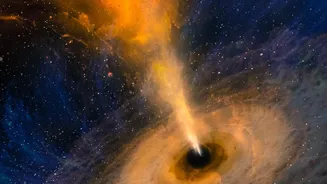
Actively feeding black holes are not just cosmic drains; they are also powerful engines of creation and chaos. The same forces that heat up the accretion disk can also launch powerful 'outflows' or winds of gas and energy back into space. These outflows can be immensely powerful, capable of shaping the entire galaxy around them. In the case of this newly discovered object, the energy from the central black hole is what's 'powering' the gas cloud, causing it to glow so intensely. This phenomenon provides a dramatic example of how black holes don't just consume their surroundings but can also energise vast clouds of gas, potentially influencing how and where future stars might form.
Seeds of a Giant
The discovery of this 'black hole star' could be a major breakthrough in understanding the early universe. Scientists have long wondered how supermassive black holes, like the one at the center of our own Milky Way, grew so large so quickly after the Big Bang. These new objects could be the missing link. They might represent a key transitional phase, showing how the first 'seed' black holes rapidly gained mass by being enveloped in enormous reservoirs of gas. If this hypothesis is correct, the many other 'little red dots' seen in Webb's deep-field images might also be black hole stars, giving astronomers a new window into the formation of the cosmic giants that anchor galaxies today. Further study is needed, but this one-in-a-billion object has opened up a thrilling new avenue of research.