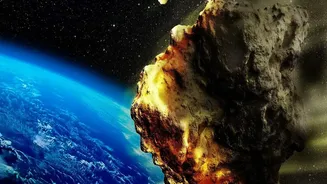





Humanity's plan to defend Earth from a rogue asteroid just got more complex. Groundbreaking new models from Sandia National Laboratories show that a space rock's lumpy, irregular shape could be the difference between success and failure.
A New Wrinkle in Planetary Defense
When it comes
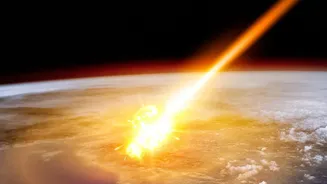
to protecting Earth from a potentially catastrophic asteroid impact, scientists have two main strategies: a kinetic impactor that rams the object, like in NASA’s DART mission, or a standoff nuclear detonation that bathes one side in X-rays, vaporizing surface material to create a powerful push. For years, simulations of these scenarios made a convenient, but incorrect, assumption: that asteroids are perfect spheres. New research led by physicist Nathan Moore at Sandia National Laboratories has shattered that simplification. By creating a highly detailed model that accounts for the real, irregular shapes of asteroids, his team discovered that where you target the object matters immensely. In their simulations, the effectiveness of a deflection attempt varied by nearly fivefold depending on which side of the lumpy asteroid was targeted.
From Sphere to Spud
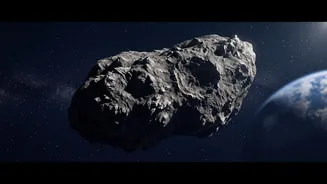
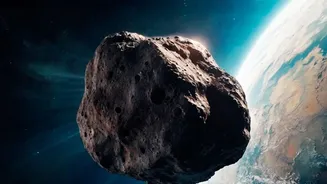
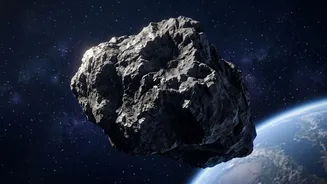
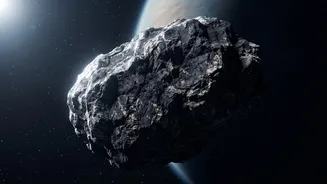
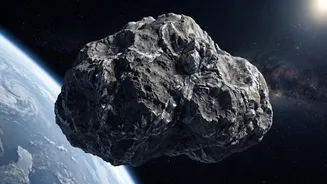
The problem with modeling asteroids as spheres is that, as Moore bluntly puts it, 'spherical asteroids don't exist'. Real asteroids are pockmarked, oblong, and asymmetrical, shaped more like potatoes than marbles. These lumps and bumps dramatically change how an asteroid reacts to a blast of energy. A standoff nuclear explosion is designed to heat the asteroid's surface, causing rock to turn to vapor and fly off, creating thrust like a rocket engine. If the surface is flat, the push is predictable. But if the blast hits a sloped surface or the side of a crater, the escaping vapor is directed at an angle, changing both the force and the direction of the push. The new Sandia model found that the resulting change in an asteroid's forward speed could be 3.9 millimeters per second from one angle but only 0.8 from another—a massive difference when trying to nudge an object millions of kilometers away.
A Faster, More Accurate Simulation
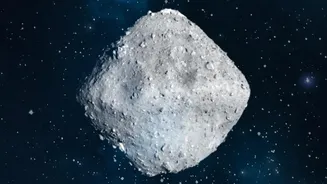
Until now, researchers faced a trade-off. They could either model an asteroid’s complex shape or perform high-fidelity calculations of the physical forces, but not both at once; the computing power required was simply too great. The Sandia team overcame this by combining two different types of sophisticated simulation software, ALEGRA and SPARTA, to create a new algorithm that is over 1,600 times faster. This breakthrough allows them to upload detailed 3D models of real asteroids—like Bennu, Itokawa, and Golevka—and simulate a nuclear X-ray burst with incredible precision. The model produces a heat map showing which parts of the surface vaporize and calculates the resulting push, changes in rotation, and potential for surface damage.
The Perils of Spin
Besides just changing an asteroid’s path, the new simulations revealed a dramatic effect on its rotation. For one simulated asteroid, the change in its spin varied by a factor of 17 depending on where the energy was directed. This is a critical factor for planetary defense. An uncontrolled tumble could make a followup mission impossible, and it complicates efforts to predict the asteroid's new trajectory. More importantly, the goal of any deflection mission is to move the asteroid without breaking it apart. Creating a cloud of smaller, stillndangerous fragments is a nightmare scenario that mission planners desperately want to avoid. While the current model can predict surface rock breakup, it cannot yet reliably determine if the entire asteroid would fracture.
Implications for Saving the World
These findings don't mean that planetary defense is impossible, but they do show that it's far from a onendsizefitsall problem. 'Our study shows how important it is to aim carefully', Moore stated. 'Pick the right side and you win. Guess wrong and it could be a bad day.' In a realworld scenario, mission planners would need highresolution images of an approaching asteroid from all sides to determine its shape. They could then use this new modeling capability to run thousands of simulations, identifying the optimal place to aim to maximize the push and minimize the risk of fragmentation. This research provides a crucial tool to make our future defense strategies smarter and significantly more effective, turning a simple concept of 'pushing an asteroid' into a precise, calculated science.