

A Groundbreaking Partnership
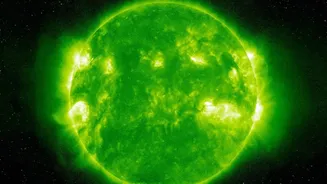
Scientists have published a first-of-its-kind study by jointly analysing observations from India’s maiden solar mission, Aditya-L1, and Europe’s innovative Proba-3 spacecraft. Led by researchers at the Indian Institute of Astrophysics (IIA) in Bengaluru,
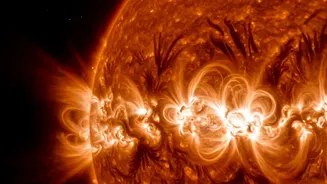
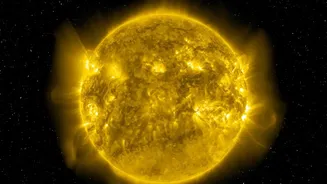
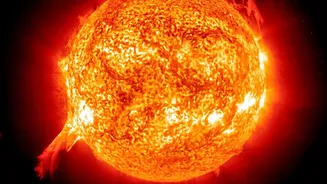
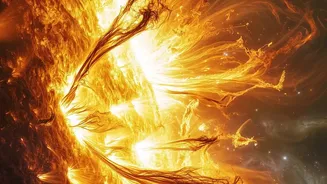
the study focuses on Coronal Mass Ejections (CMEs), which are massive eruptions of plasma and magnetic fields from the Sun. This international effort provides an unprecedented, combined view of these powerful events, marking a significant milestone for both the Indian Space Research Organisation (ISRO) and the European Space Agency (ESA). The findings, published in the journal 'Astronomy & Astrophysics', demonstrate how combining data from different advanced missions can lead to a deeper understanding of solar phenomena that was not possible with a single spacecraft alone.
Two Missions, One Unique View
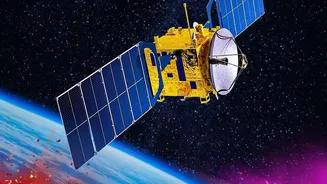
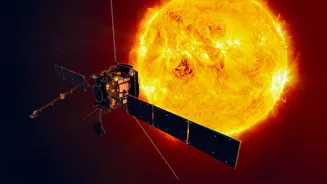
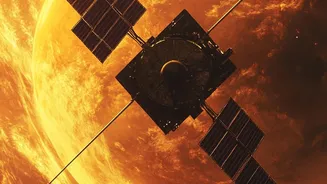
The success of this research lies in the complementary capabilities of the two missions. India's Aditya-L1, stationed at the first Lagrange point (L1) 1.5 million kilometres from Earth, has an uninterrupted view of the Sun. Its Visible Emission Line Coronagraph (VELC) payload performs spectroscopy, providing crucial data on the temperature and density of the coronal plasma very close to the Sun's surface. Meanwhile, ESA’s Proba-3 is a technological marvel—the world's first precision formation-flying mission. It uses two satellites flying in a perfect 150-metre alignment to create an artificial solar eclipse, allowing its coronagraph, ASPIICS, to image the faint, outer corona which is usually blinded by the Sun's brilliance. While ASPIICS captures the shape and movement of a CME, VELC measures the properties of the plasma erupting. This synergy provides a more complete picture of a CME's birth and early evolution.
Decoding Solar Eruptions
The team analysed two specific CMEs observed in September 2025, revealing stark differences. One eruption travelled at a blistering 645 km per second, while the other moved at a more leisurely 145 km per second. By combining the imaging from Proba-3 and spectroscopic data from Aditya-L1, the scientists were able to measure the mass, density, and energy distribution of these eruptions with greater accuracy. They found that the slower eruption expanded more strongly in its early stages. The study also provided new clues to one of solar physics' biggest mysteries: the coronal heating problem. The corona is inexplicably hundreds of times hotter than the Sun's surface, and understanding how CMEs distribute thermal and magnetic energy offers vital clues to the mechanisms heating this outer atmosphere.
Why This Matters for India and the World
Studying CMEs is not just an academic exercise. When these eruptions are aimed at Earth, they can cause 'space weather'—geomagnetic storms that pose a significant threat to our technologically dependent society. These storms can disrupt satellite communications, damage GPS navigation systems, cripple power grids, and endanger astronauts. For a nation like India, with its expanding satellite constellations, digital economy, and missions like Gaganyaan, understanding and predicting space weather is a matter of strategic importance. A severe solar storm has the potential to impact everything from online banking and aviation to national security infrastructure. This joint study enhances our ability to model the early behaviour of CMEs, a critical step towards more reliable space weather forecasting.