




A Fiery, Molten Beginning
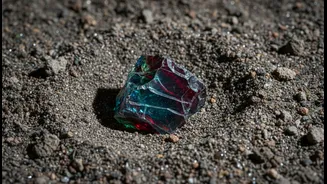
Imagine the Moon, not as the tranquil, grey orb we see today, but as a glowing, violent ball of molten rock. This is the 'Lunar Magma Ocean,' a widely accepted theory about the Moon's infancy, around 4.5 billion years ago. Scientists believe that the energy
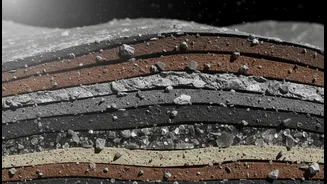
from the Moon's very formation—likely from a giant impact with a young Earth—was so immense that it melted the outer layers into a deep, global ocean of magma. As this ocean slowly cooled over hundreds of millions of years, different minerals crystallised and either sank or floated. The lighter minerals, like anorthosite, rose to the top to form the Moon's primordial crust, while heavier minerals sank to form the mantle. Studying this ancient process is key to understanding how the Moon, and other rocky bodies like Earth, evolved.
India’s Scientific Outpost
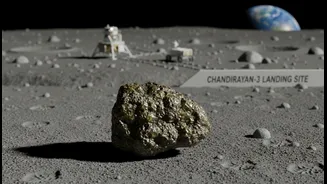
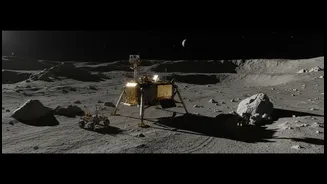
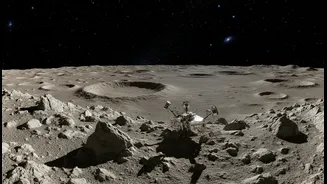
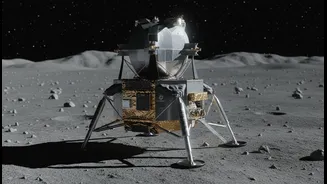
Shiv Shakti Station is the name given to the landing site of the Chandrayaan-3 mission's Vikram lander, located in the strategically important south polar region of the Moon. While the successful soft landing was a historic feat of engineering for India, the location's true purpose is scientific discovery. The Vikram lander wasn't just a passenger vehicle; it was equipped with a suite of advanced scientific instruments designed to conduct experiments on the lunar surface. It is the first-ever landing in this region, giving Indian scientists access to a unique and relatively untouched area of the Moon, which holds clues that can’t be found at the equatorial sites visited by previous missions.
The Tools for Discovery
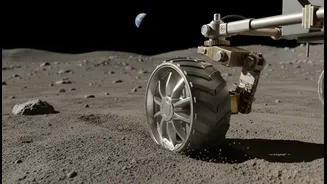
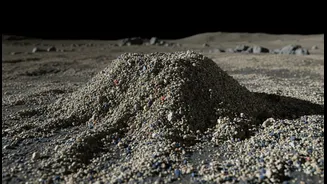
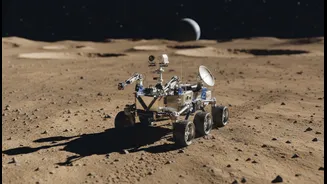
To peer back into the Moon's history, ISRO equipped the lander and rover with several key instruments. On the lander, the Chandra’s Surface Thermophysical Experiment (ChaSTE) and the Instrument for Lunar Seismic Activity (ILSA) are crucial. ChaSTE is designed to measure the thermal properties of the lunar soil, taking its temperature at various depths. This helps scientists understand how heat flows from the Moon's interior. ILSA, meanwhile, is a sensitive seismometer designed to listen for 'moonquakes' and meteorite impacts, which can help map the structure of the crust and mantle. On the Pragyan rover, the Alpha Particle X-ray Spectrometer (APXS) and Laser-Induced Breakdown Spectroscope (LIBS) analyse the elemental and mineral composition of the soil and rocks.
Connecting Data to Deep Time
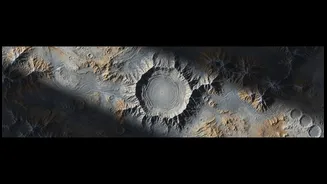
The data from these instruments provides physical evidence to test the magma ocean theory. For instance, ChaSTE's thermal readings can help model how quickly the ancient magma ocean cooled. ILSA's seismic data can reveal the thickness of the crust formed from that cooling process. Most compellingly, the APXS instrument has found that the soil at Shiv Shakti Point is rich in magnesium and iron, and has a composition that suggests a mix of materials from different crustal layers. Scientists believe this material was excavated from deep within the Moon by the massive impact that created the nearby South Pole-Aitken basin and then scattered across the surface. This gives a rare glimpse into the composition of the Moon's lower crust and upper mantle—the very layers formed when the magma ocean first solidified.
Rewriting Lunar History from India
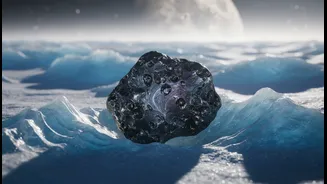
The analysis flowing from Chandrayaan-3 is already making waves. Recently, scientists from the Physical Research Laboratory (PRL), Ahmedabad, found a striking geochemical similarity between the soil at Shiv Shakti Point and a lunar meteorite, ALHA 81005, found in Antarctica in 1982. This connection helps validate that the materials at the landing site represent a type of ancient lunar crust. By directly sampling and analysing this unique location, ISRO is providing ground-truth data that no orbiting satellite can. This information helps confirm and refine the Lunar Magma Ocean hypothesis, adding crucial new details to the story of the Moon’s formation. The engineering achievement of Chandrayaan-3 has transformed into a powerful scientific engine, driving a deeper understanding of our closest celestial neighbour.