




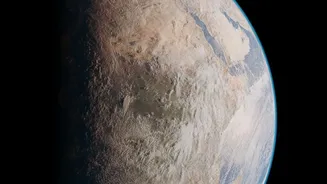


Meet Your Galactic Neighbour
First discovered in 2017, LHS 1140 b is a “super-Earth,” a category of planet more massive and larger than our own but smaller than Neptune. It weighs in at about 5.6 times the mass of Earth and has a radius roughly 1.7 times larger. This fascinating
world orbits a red dwarf star—the most common type of star in our galaxy—which is much smaller, cooler, and dimmer than our sun. The planet circles its star every 25 days, putting it well within the star’s habitable zone. This is the “Goldilocks” region where temperatures could be just right for liquid water to exist on a planet's surface, a key ingredient for life as we know it. For years, this combination of traits has made LHS 1140 b a top-tier candidate for further investigation.
Why Proximity Is Everything
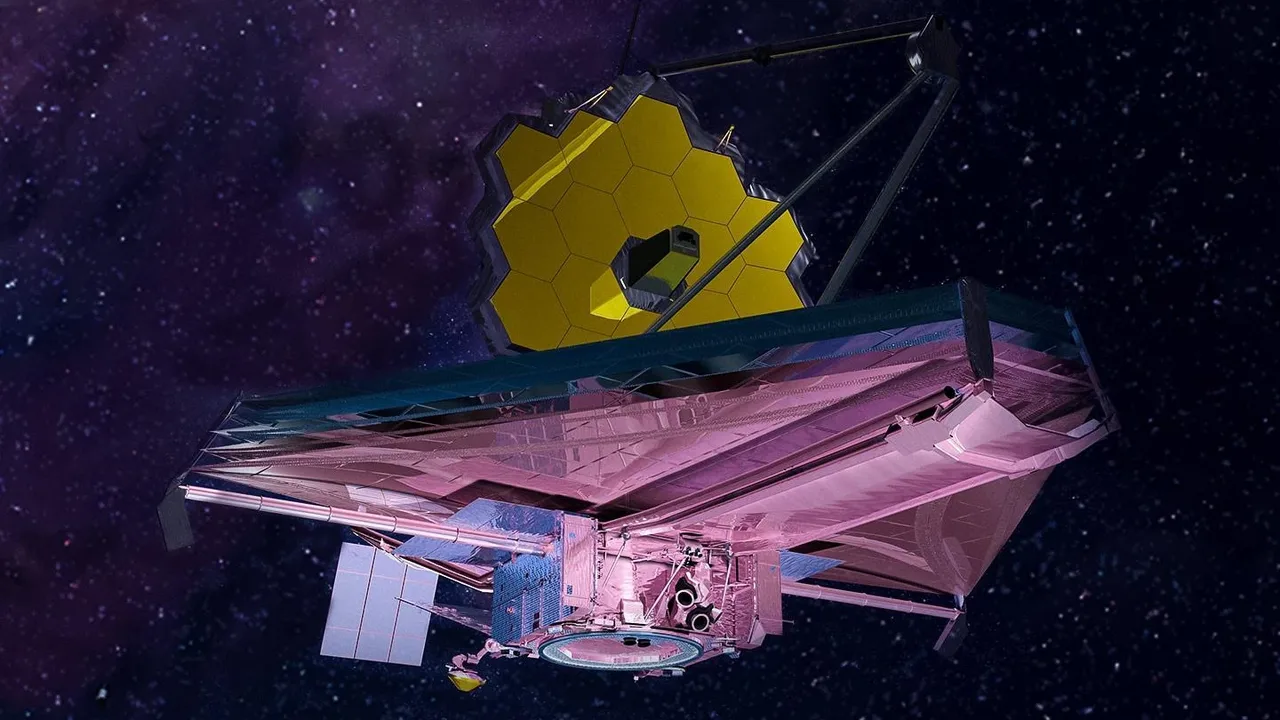
The 48-light-year distance mentioned in the headline is crucial. While it would still take our fastest current spacecraft hundreds of thousands of years to get there, for telescopes, it's a manageable distance. Light from the LHS 1140 system takes about 48 years to reach Earth, meaning we are observing the planet as it was in the late 1970s. This proximity makes the starlight we receive from it brighter and clearer than light from more distant systems. When LHS 1140 b passes in front of its star from our perspective—an event called a transit—telescopes like the James Webb Space Telescope (JWST) can analyze the starlight that filters through the planet's atmosphere. The closer the star, the stronger that signal, giving scientists a precious opportunity to decipher the chemical makeup of the air on another world.
A Quiet Star and a Glimmer of Atmosphere
Many red dwarf stars are known for being volatile, unleashing powerful flares of radiation that could strip away the atmospheres of nearby planets. Fortunately, LHS 1140 is a relatively old and quiet star, which improves the odds that its planet could have held onto an atmosphere over billions of years. And in a major breakthrough, recent observations have provided the first confirmed evidence of an atmosphere on a rocky planet in a habitable zone. In a study published in mid-2026, astronomers detected helium escaping from the planet's upper atmosphere. This is a landmark discovery, as an atmosphere is essential to regulate temperature and shield a planet from harmful radiation, two critical factors for habitability.
From Rocky World to Water World?
The scientific story of LHS 1140 b is one of evolving understanding. Initially, its mass and radius suggested it was a dense, rocky planet. However, more precise measurements, including recent data from the JWST, have refined this picture. The planet is less dense than first thought, which has led to a compelling new theory: LHS 1140 b could be a water world. Scientists now estimate that 10% to 20% of the planet's mass could be water. JWST observations have also ruled out a thick, hydrogen-dominated atmosphere, which strengthens the case for a world with a denser atmosphere, possibly rich in nitrogen, carbon dioxide, and water vapor. This makes it a far more intriguing target in the search for life.
A 'Bull's-Eye' Ocean on an Icy Planet?
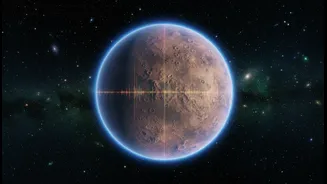
The latest models paint a tantalizing, if alien, picture. Because it orbits its dim star so closely, LHS 1140 b is likely tidally locked, meaning one side always faces the star, just as the same side of the Moon always faces Earth. This could create a unique climate. Some researchers propose that the planet might be a snowball world, but with a large, circular ocean of liquid water at the sub-stellar point—the 'bull's-eye' directly facing the star's warmth. This ocean could be thousands of kilometers in diameter, and at its center, surface temperatures might even be a comfortable 20 degrees Celsius. Confirming this and detecting key atmospheric gases like carbon dioxide will require years of further observation with the JWST, but the possibility keeps astronomers eagerly pointed toward this nearby world.