

The Great Lunar Blackout
For as long as we've sent missions to the Moon, we've faced a fundamental problem. The Moon is tidally locked with Earth, meaning we only ever see one side. The other hemisphere, the far side, is permanently turned away from us. This isn't an issue for
sunlight—it gets just as much as the near side—but it's a massive problem for communication. Radio waves don't pass through thousands of kilometres of solid rock, so any astronaut or rover on the far side is in a complete communication blackout zone with Earth. During the Apollo missions, astronauts orbiting the Moon experienced this firsthand, enduring periods of total radio silence every time they passed behind it. This communication barrier has severely limited our ability to explore what is a scientifically fascinating and rugged landscape.
A Celestial Wi-Fi Network
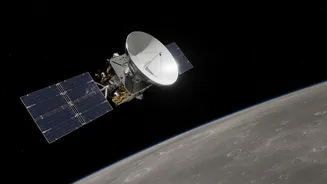
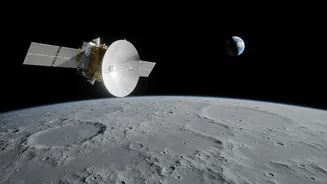
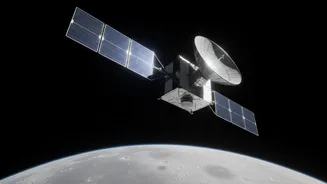
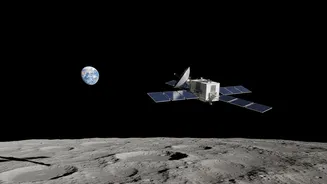
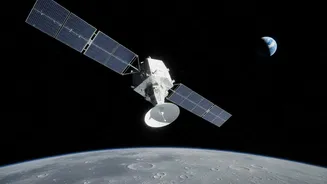
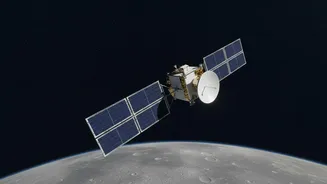
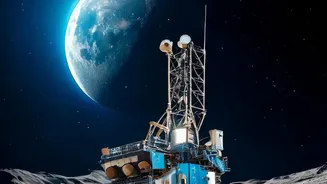
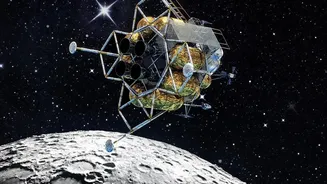
NASA's solution is a dedicated network of lunar relay satellites. The concept is straightforward: place satellites in orbit around the Moon that can 'see' both ground stations on Earth and assets on the lunar surface simultaneously. These satellites act like a celestial data forwarding service. A signal from a rover on the far side travels up to the relay satellite, which then bounces it around the Moon and back to mission control on Earth. This initiative, part of NASA's Lunar Communications Relay and Navigation Systems (LCRNS) project, aims to create an internet-like service for the Moon called LunaNet. This network will not only provide communication but also crucial navigation data, like a GPS system for the Moon. The Lunar Gateway, a future space station in orbit around the Moon, will also play a key role, serving as a major communications hub for various lunar missions.
Unlocking New Frontiers for Science
With continuous communication, the far side transforms from a high-risk, isolated region into a prime target for scientific discovery. One of the most exciting possibilities is radio astronomy. The far side is shielded from the constant radio noise emanating from Earth, making it the most radio-quiet location in the inner solar system. This pristine environment is perfect for building telescopes that could listen for faint signals from the early universe, free from terrestrial interference. Geologists are also eager to study the far side's unique crust and the massive South Pole-Aitken Basin, one of the largest and oldest impact craters in the solar system, which could hold clues to the Moon's formation.
Powering the Artemis Generation
These relay satellites are not just for robots; they are essential for the safety and success of future human missions under the Artemis program. For astronauts establishing a sustained presence on the Moon, especially around the targeted South Pole region where direct line-of-sight to Earth can be intermittent, reliable communication is a lifeline. It allows for real-time conversations with mission control, transmission of vital health data, and high-definition video streams. NASA is partnering with commercial companies like Intuitive Machines to build and deploy these relay satellites, ensuring the infrastructure is in place to support astronauts, rovers, and landers for the long term. The first of these systems are being developed and integrated for launch in the coming years.
A Critical Step on the Path to Mars
Ultimately, building a robust communications and navigation network around the Moon is about more than just lunar exploration. NASA views it as a crucial dress rehearsal for humanity's next giant leap: sending astronauts to Mars. The communication challenges at Mars will be even more complex due to the immense distances involved. By developing and perfecting relay technologies, autonomous systems, and network protocols like LunaNet in our own cosmic backyard, NASA is building the experience and infrastructure needed for a sustainable human presence across the solar system. The lessons learned from connecting the far side of the Moon today will directly inform how we stay connected to the first human explorers on the Red Planet tomorrow.