


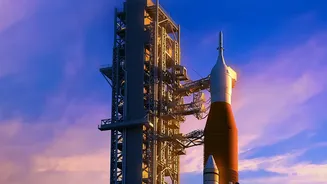
The Ultimate Ejection Seat
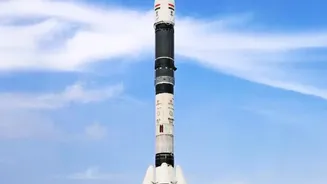
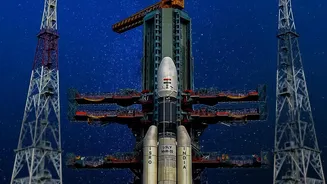
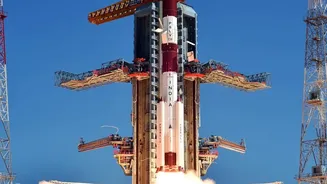
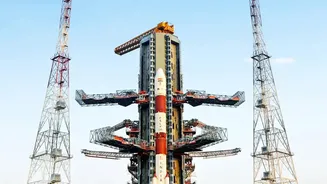
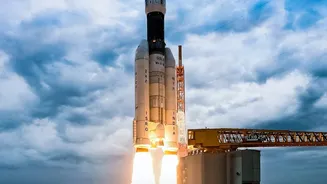
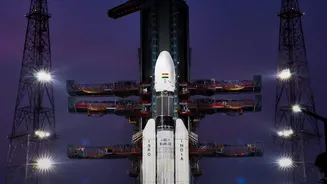
Before the massive LVM3 rocket can ever lift our 'Vyomanauts' (astronauts) towards the stars, ISRO has to perfect a plan for what happens if the launch goes wrong. The most crucial piece of this puzzle is the Crew Escape System (CES). This isn't just
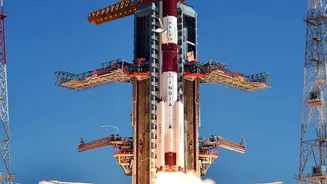
a simple parachute; it's a powerful, quick-acting rocket system mounted on top of the crew capsule. If any critical anomaly is detected on the launch pad or during ascent, the CES is designed to fire its solid fuel motors and violently pull the crew module away from the main rocket, carrying the astronauts to a safe distance. ISRO has been exhaustively testing this system through a series of abort missions, including the Pad Abort Test (PAT) to simulate an emergency on the launchpad and in-flight abort tests at various altitudes and speeds. Every test provides vital data to ensure the escape system works flawlessly when seconds could mean the difference between life and death.
Perfecting the Parachutes
Getting the crew to safety after an abort or a successful mission requires more than just a single parachute. The Gaganyaan module uses a complex, multi-stage deceleration system to slow its descent. This involves a sequence of ten parachutes deploying in a precise order. First, smaller pilot and drogue parachutes are deployed at high altitudes to stabilize the capsule and begin reducing its speed. This is followed by the deployment of three massive main parachutes that slow the capsule to a gentle splashdown speed of around 10-12 metres per second. To validate this entire sequence, ISRO is conducting a series of Integrated Air Drop Tests (IADT). In these tests, a Chinook helicopter lifts a boilerplate module—a mock-up identical in weight and size to the real capsule—to a specific altitude and drops it, allowing engineers to verify the entire parachute deployment and descent performance in real-world conditions.
The Uncrewed Dress Rehearsals
Before any human flies, the entire mission profile must be tested from start to finish. This will be done through a series of at least two to three uncrewed test flights. The first of these, the G1 mission targeted for late 2026, will be a full-fledged spaceflight without astronauts. In their place will be Vyommitra, a sophisticated humanoid robot developed by ISRO. Vyommitra can mimic human functions, monitor the cabin environment, and operate the switch panels, providing invaluable data on how the life support and other critical systems perform in the harsh environment of space. These uncrewed missions will test every aspect of the Gaganyaan system: the launch of the human-rated LVM3 rocket, the performance of the orbital and service modules in space, the complex re-entry and heat-shield procedures, and the final splashdown. Only after these missions are completed successfully will ISRO greenlight the first crewed flight, H1.
Splashdown and Safe Recovery
The mission doesn't end when the capsule touches the water. A swift and safe recovery of the crew module and its occupants is the final, vital step. ISRO has been working in close coordination with the Indian Navy to perfect these recovery procedures. Using a mock-up of the crew capsule, joint teams have been conducting extensive trials in pools, harbours, and the open sea off the coast of Visakhapatnam. These drills fine-tune every part of the operation, from attaching flotation devices and towing the capsule to safely hoisting it aboard a naval vessel using a ship's well deck. Another critical system tested is the Crew Module Up-righting System (CMUS), a gas-based flotation system that ensures the capsule remains upright after splashdown, even in choppy seas, keeping the astronauts stable and safe while they await pickup.