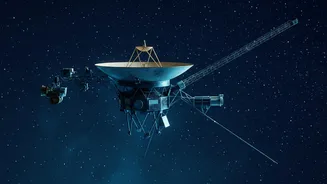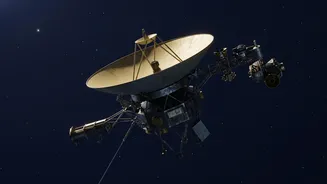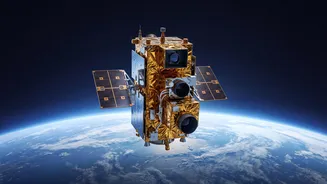




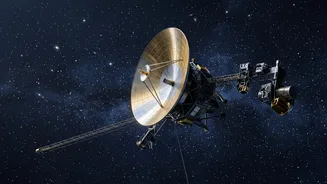
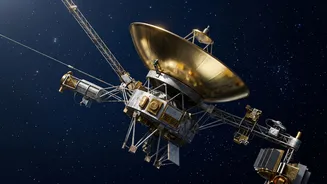
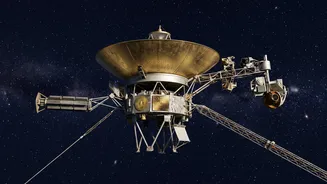
After nearly 22 years of revolutionising our view of the cosmos, NASA’s Neil Gehrels Swift Observatory has taken its final bow. The pioneering spacecraft concluded its mission with a dramatic re-entry into Earth's atmosphere on November 4.
The Final Plunge
On Wednesday,
November 4, the story of the Swift Observatory came to a fiery end. The U.S. Space Force confirmed the spacecraft re-entered the atmosphere at 7:39 a.m. EST over the North Sumatra region of Indonesia. This was an uncontrolled re-entry, a final consequence of Earth's atmospheric drag slowly pulling the satellite from its orbit. Increased solar activity over the past couple of years had intensified this drag, causing Swift's orbit to decay more rapidly than anticipated. Although NASA expected most of the 1.6-ton spacecraft to vaporise during its high-speed descent, it is possible some components survived the journey and reached the surface. The space agency had previously stated the risk of harm to anyone was very low, estimated at approximately 1 in 2,100.
A Daring Rescue Attempt
The end of Swift's mission was not for a lack of trying. As its orbit began to rapidly decay, NASA initiated a high-risk rescue mission. In September 2025, the agency awarded a contract to Katalyst Space to design and build a robotic servicing spacecraft called LINK. Launched in July 2026, the LINK spacecraft was intended to perform a first-of-its-kind manoeuvre: to grab Swift and boost it into a higher, more stable orbit. However, the ambitious mission encountered technical problems shortly after launch. The LINK spacecraft suffered a failure in its attitude-control system and began to tumble, making the capture impossible. With the rescue called off in August, Swift's fate was sealed.
A Hunter of Cosmic Explosions
Launched in November 2004, Swift was a first-of-its-kind observatory designed for a two-year mission to solve the mystery of gamma-ray bursts (GRBs). These are the most powerful explosions in the universe, often signalling the birth of a black hole or the collision of dense neutron stars. Swift's genius was its speed. Its trio of telescopes worked in concert: the Burst Alert Telescope would spot a GRB, and within seconds, the entire spacecraft would pivot to aim its X-ray and Ultraviolet/Optical telescopes at the event to study its fading afterglow. This rapid response allowed astronomers, for the first time, to study these fleeting events in detail and alert ground-based observatories to join the chase.
Two Decades of Discovery
Swift vastly outlived its initial two-year plan, operating for nearly 22 years and becoming one of astrophysics' most productive tools. It observed over 2,000 gamma-ray bursts, including the most distant one ever detected, which exploded when the universe was just a fraction of its current age. But its capabilities went far beyond GRBs. Swift became a versatile 'target of opportunity' observatory, studying everything from over 1,400 supernovae to comets and asteroids in our own solar system. It watched stars get torn apart by supermassive black holes and helped create the first all-sky survey in high energy X rays. The mission's data contributed to roughly 7,000 scientific papers, cementing its role in a revolution in time domain astronomy — the study of how the universe changes over time.