




The Specialists: Hubble and Webb
Before welcoming the newcomer, it's worth remembering what makes its predecessors so iconic. The Hubble Space Telescope, a household name for over thirty years, provides incredibly sharp images in visible and ultraviolet light. It’s the master of the high-resolution
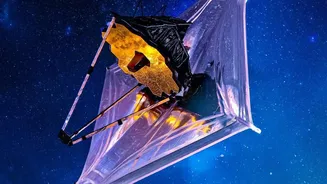
portrait, capturing individual galaxies and nebulae in stunning detail. The James Webb Space Telescope, its more recent companion, is an infrared specialist. Its giant mirror and extreme sensitivity allow it to peer back to the dawn of time, studying the very first stars and galaxies to form after the Big Bang. Both are like cosmic snipers, designed to aim at a specific target and study it with intense focus. Their fields of view are relatively small, like looking at the sky through a keyhole to see one thing perfectly.
Introducing the Panoramic Surveyor
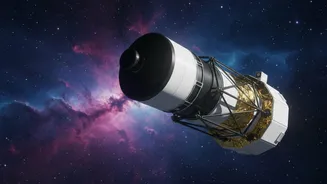
The new arrival, NASA's Nancy Grace Roman Space Telescope, launched on August 30, 2026, is built for a completely different job. Named after NASA's first chief of astronomy, Roman is a survey telescope. Its primary mirror is the same 2.4-meter size as Hubble's, but its camera is where the revolution lies. The Wide Field Instrument is a 300-megapixel powerhouse designed to capture enormous swathes of the sky in a single shot. Think of it this way: if Hubble and Webb are taking portraits, Roman is shooting massive, panoramic landscapes. It is less a device for photographing single objects and more a machine for mapping the entire sky at incredible speed.
What 'Panoramic' Really Means
The key difference is the field of view. Roman can see a patch of sky at least 100 times larger than Hubble or Webb can in a single pointing, all while maintaining Hubble-like image sharpness. What this means in practice is astonishing efficiency. To create a complete mosaic of the neighboring Andromeda galaxy, Hubble required over 400 separate images. Roman could capture the same area in just two. In its first five years, it is expected to image an area of the sky 50 times larger than what Hubble has covered in its entire 30-plus year mission. This ability to generate vast, high-resolution maps of the universe is what makes Roman a game-changer, enabling scientists to study the cosmos on a grand, statistical scale for the first time.
A New Toolkit for Cosmic Mysteries
This wide-angle approach is specifically designed to tackle two of the biggest mysteries in cosmology: dark energy and dark matter. Dark energy is the enigmatic force causing the universe's expansion to accelerate, while dark matter is the unseen substance whose gravity holds galaxies together. By surveying billions of galaxies and thousands of exploding stars called supernovae, Roman will map the structure of the universe across cosmic time. This will allow scientists to measure the effects of dark energy and map the distribution of dark matter with unprecedented precision. Furthermore, Roman is set to discover thousands of new exoplanets, including worlds smaller than Earth and rogue planets that drift through space without a parent star, primarily using a technique called gravitational microlensing.
Stronger Together
Roman's launch does not signal the retirement of its famous partners. Instead, it ushers in an era of unprecedented teamwork. Roman is the ultimate scout. Its rapid surveys will identify countless fascinating and rare cosmic objects—unusual galaxies, distant supernovae, or promising exoplanet systems. Astronomers can then use the powerful, focused abilities of Webb and Hubble to perform detailed follow-up observations on these targets. Roman finds the cosmic points of interest in the vastness of space, and Webb and Hubble zoom in for the close-up investigation. This synergy will dramatically increase the scientific return of all three observatories, giving us a more complete picture of the universe than ever before.