





What Did Scientists Actually Discover?
Deep below the Pacific Ocean, a massive river of liquid iron flowing in Earth's outer core suddenly changed course. For years, scientists had observed this flow moving generally westward. But in 2010, this pattern dramatically flipped. A broad section
of the molten material, located about 2,200 kilometres beneath the surface, switched from a weak westward drift to a strong eastward flow. This discovery, detailed in recent studies, challenges the long-held view that the core's large-scale circulation was a relatively stable, slow-changing system. The term "reversal" might sound alarming, but it's important to clarify this isn't the entire core flipping over, nor is it a reversal of the planet's magnetic poles. Rather, it is a regional, albeit significant, change in the direction of fluid motion in one part of the outer core.
How Can Satellites See Inside the Earth?
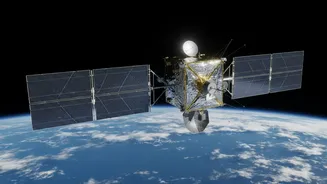
We can't send a probe into the Earth's core, where temperatures soar to thousands of degrees. Instead, scientists use indirect methods to understand this inaccessible realm. The key is the planet's magnetic field, which is generated by the movement of the electrically-conductive liquid iron in the outer core. This process is known as the geodynamo. Tiny fluctuations in the magnetic field at the surface can reveal details about the churning liquid metal deep below. A fleet of highly sensitive satellites, most notably the European Space Agency's (ESA) Swarm constellation, provides incredibly precise measurements of this magnetic field. Launched in 2013, the three Swarm satellites fly in carefully coordinated orbits, allowing researchers to separate the magnetic signals coming from the core from other sources like the Earth's crust or activity in the upper atmosphere. By analysing nearly three decades of data from Swarm and other missions like CHAMP and Ørsted, scientists were able to reconstruct the flow patterns at the boundary of the core and spot the abrupt change in 2010.
Is This Sudden Reversal a Cause for Concern?
While a sudden change deep inside the planet sounds dramatic, scientists say this event poses no immediate danger to life on the surface. The reversal is happening on geological timescales and thousands of kilometres underground. Its direct effects aren't felt by us. However, the discovery is forcing a major rethink of how the planet's interior works. Researchers are now trying to understand what caused the shift and what it means for the future. Was it a brief, one-off fluctuation, or is it part of a recurring natural cycle? Some of the latest data suggests the strong eastward flow has already started to weaken since 2020, adding weight to the idea that this might be a temporary oscillation. The cause remains a mystery, but some scientists hypothesize it could be linked to even deeper events, possibly involving the solid inner core.
Why This Discovery Is a Big Deal
This discovery is significant for several reasons. Firstly, it provides a rare, clear view of the dynamic and sometimes rapid changes happening within the Earth's core, showing it may be far more variable than once believed. Secondly, it deepens our understanding of the geodynamo, the engine that powers our planet's protective magnetic shield. This magnetic field is crucial for life, as it deflects harmful charged particles from the sun that would otherwise strip away our atmosphere. Understanding how the core's flow changes helps scientists refine models of the magnetic field's behavior, which is important for everything from satellite navigation to studying space weather. Ultimately, this satellite-powered glimpse into the abyss highlights a new era of discovery, where space technology allows us to solve mysteries hidden in the very heart of our own planet.