

What is the 'Starship Catch'?
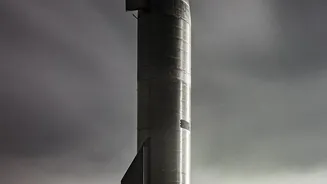
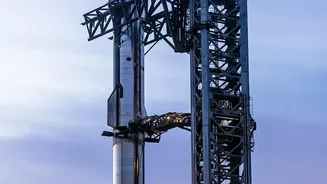
The 'Starship Catch' refers to SpaceX's plan to recover its massive Starship spacecraft and its even larger Super Heavy booster using the launch tower itself. Instead of the rockets landing on legs, a pair of giant mechanical arms on the launch tower,
nicknamed 'Mechazilla' or the 'chopsticks', are designed to grab the descending rocket stages mid-air. The goal is to catch the Super Heavy booster just minutes after launch and, in a more complex operation, catch the Starship upper stage after it returns from orbit, a process that can take nearly a full day. This method is the cornerstone of making the entire launch system fully and rapidly reusable.
The Evolution from Legs to Arms
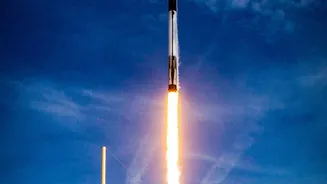
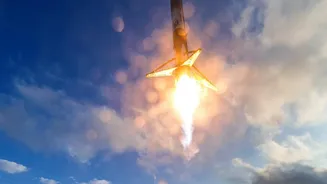
SpaceX pioneered rocket reusability with its Falcon 9 boosters, which use landing legs to touch down on droneships or landing pads. Early designs for Starship also featured landing legs. However, the company pivoted to the more audacious catch system for two primary reasons: mass and speed. Landing legs for a vehicle as enormous as Super Heavy would be incredibly heavy, and every kilogram dedicated to landing gear is a kilogram lost from the rocket's payload capacity. By removing the legs, Starship can carry more cargo or fuel. Secondly, the catch system is designed for an almost impossibly fast turnaround.
Why the Catch Is a Game-Changer
Catching the rocket is about more than just an engineering spectacle; it is fundamental to SpaceX's business model for space exploration. The primary benefit is the potential for airline-like launch operations. A booster caught by the tower is already at the launch site, ready to be placed back on the launch mount, refuelled, and stacked with a new spacecraft within hours or days, not weeks. This rapid turnaround is essential for deploying large satellite constellations like Starlink and for missions to the Moon and Mars, which will require numerous launches in quick succession for in-orbit refuelling. By eliminating transportation from a remote landing zone and simplifying ground operations, the catch system could dramatically reduce the cost of space access.
The Mechanics of a Mid-Air Catch
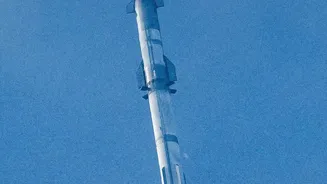
The process is a feat of precision engineering. After separating from the Starship spacecraft, the Super Heavy booster performs a series of engine burns to reverse its course and return to the launch site. As it approaches the tower, it executes a final landing burn to slow its descent to nearly a hover. The vehicle must guide itself with pinpoint accuracy to position itself between the open 'chopstick' arms of the tower. Using a combination of high-resolution cameras, LiDAR, and advanced control systems, the tower tracks the vehicle's final approach. The arms then close around structural hard points on the rocket—the same grid fins used for aerodynamic steering—to secure the vehicle. The entire manoeuvre is automated, with both the booster and the tower making real-time calculations to ensure a safe capture.
The Risks and the Rewards
The manoeuvre is fraught with risk. A miscalculation in timing or positioning by mere centimetres could result in the catastrophic loss of both the booster and the invaluable launch tower. The returning booster's engines fire at close range to the tower, creating an extreme thermal and acoustic environment that the structure must withstand. However, the reward for perfecting this system is transformative. Successful and routine catches are what make the concept of a 'fully and rapidly reusable' launch system a reality. It's the final, and perhaps most difficult, piece of the puzzle that could lower the cost of reaching orbit by a factor of one hundred, according to SpaceX.
Flight 15: A Critical Test
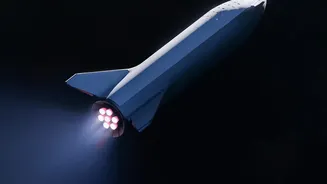
The recent Starship Flight 15 mission was a crucial step in this process, marking the first time SpaceX attempted to catch both the Super Heavy booster and the Starship upper stage in a single mission. While the company has successfully caught Super Heavy boosters on previous flights, Flight 15 saw the first-ever successful catch of a Starship upper stage after it spent over 22 hours in orbit. However, the mission also highlighted the system's challenges, as an automated abort diverted the booster to a splashdown in the Gulf of Mexico instead of being caught. This split result demonstrates both the incredible potential of the catch system and the remaining hurdles before it becomes a routine operation.