





Understanding the Swing
When we talk about 'swing exercises', the kettlebell swing is the undisputed champion. Though you can perform swings with dumbbells or other implements, the kettlebell's shape is ideal for this ballistic movement. The exercise is not a squat and it's
not an arm lift; it's a hip hinge. Power is generated from your glutes and hamstrings, snapping your hips forward to propel the weight up. Your arms just guide the bell. Before attempting any variations, it's crucial to master this fundamental hip-hinge pattern to ensure both safety and effectiveness.
Scale with Foot Position
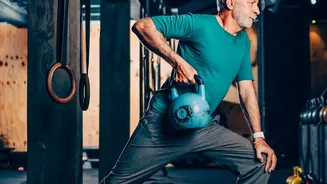
The foundation of your swing is your stance. Changing it is one of the simplest ways to alter the difficulty and focus of the exercise. A standard swing uses a stance slightly wider than shoulder-width, which provides a solid base of support. To increase the challenge to your stability and core, try narrowing your stance. This forces your trunk to work harder to prevent rotation. For a more advanced variation, adopt a 'staggered' stance, where one foot is slightly behind the other, as if on a kickstand. This introduces a unilateral element, forcing the front leg and opposite side of your core to take on more of the load, which is excellent for building functional, real-world strength. How wide you stand can depend on your body and the size of the kettlebell; you need enough room for it to pass between your legs safely.
Scale with Range of Motion
Another powerful way to scale the swing is by adjusting how high the kettlebell travels. The standard 'Russian' kettlebell swing, perfect for beginners and for focusing on pure power, involves swinging the bell to about chest height. The power comes entirely from the hip drive, and the bell 'floats' momentarily at its peak. For a greater challenge that brings in more shoulder and core stability, there is the 'American' swing, where the bell travels all the way overhead. This variation requires more mobility and control, and it's essential that the ribs stay locked down to avoid arching the lower back. Beginners can start with a reduced range of motion, focusing on the powerful hip hinge without worrying about a high swing, which helps develop timing and control.
Combining for a New Challenge
Once you're comfortable with individual modifications, you can combine them. Try a single-arm swing (a progression that dramatically increases the anti-rotation demand on your core) from a staggered stance. This highly advanced variation requires immense core control to keep your shoulders and hips square as the weight tries to pull you off-balance. You can also experiment with 'dead stop' swings, where the kettlebell comes to a full stop on the ground after each rep. This removes the momentum from the backswing, forcing you to generate maximum power from a dead start every single time. These combinations are fantastic for breaking through plateaus and developing athletic, resilient strength.
Safety Always Comes First
No matter how you modify your swing, safety remains paramount. Always maintain a flat back during the hinge; rounding your lower back is a common mistake that can lead to injury. Engage your core by bracing your abdominals throughout the movement. The power should always come from a forceful hip snap, not from lifting with your arms or shoulders. Start with a lighter weight than you think you need, especially when trying a new variation for the first time. It is better to master the form with a lighter load before increasing the weight. Finally, ensure you have a clear, safe space around you, as the swing is a dynamic movement.