







India's Digital Foundation Is Booming
India's digital economy is expanding at a breakneck pace, and at its heart is the data centre — the physical engine room of the cloud. The country's data centre capacity has been on a steep upward trajectory, growing from roughly 375 megawatts (MW) in 2020
to around 1.8 gigawatts (GW) by mid-2026. Projections show this is just the beginning. Driven by a surge in cloud adoption, massive government digitization projects, and the explosive growth of artificial intelligence, India’s data centre capacity is forecast to reach as high as 9 GW by 2030. This expansion represents a monumental investment, with commitments from global and domestic giants reaching into the tens of billions of dollars. This buildout is no longer concentrated in Mumbai alone; new hubs are rapidly emerging in Chennai, Hyderabad, and Delhi NCR as the industry scales up.
The Unique Energy Thirst of AI
Not all data centre workloads are created equal, and AI is in a league of its own when it comes to energy consumption. A single query on an AI model like ChatGPT can use nearly ten times the electricity of a simple Google search. This is because training and running complex AI models require dense clusters of powerful, energy-intensive hardware like GPUs. Globally, the electricity consumption from these 'accelerated servers' is projected to grow by 30% annually. Cooling these hardworking machines accounts for a significant portion of a data centre's energy bill, often around 40%, a particular challenge in India's hot climate. Consequently, data centre capacity is now often measured not just in computing power, but in the megawatts of electricity it consumes, making energy the primary constraint for AI expansion.
A National Power Grid Under Pressure
This unprecedented demand from data centres poses a significant challenge to India's national power grid. The government has already factored a projected demand of 13.56 GW from data centres by 2032 into its national transmission planning. While India's total installed capacity is over 520 GW, the grid's challenge lies in managing reliability and peak loads. Data centres require an almost perfectly stable, 24/7 power supply, a standard that can be difficult to maintain across all regions of the country. The clustering of these power-hungry facilities in specific corridors can strain local power networks, with a single large data centre consuming as much electricity as 100,000 homes. As a result, grid constraints and the ability to provide reliable, uninterrupted power are becoming the primary bottlenecks for further growth, even more so than land or capital.
Can Green Energy Be the Answer?
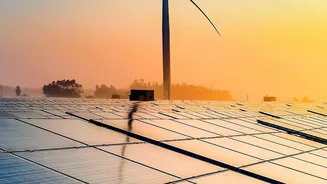
The immense energy demand from data centres presents both a challenge and a massive opportunity for India's renewable energy sector. Many large operators and hyperscalers are actively seeking green energy solutions to meet their sustainability goals and manage operational costs. India's government is encouraging this shift through policies like the Green Open Access Rules, which allow large consumers to buy renewable power directly from producers. In principle, India's target of 500 GW of non-fossil fuel capacity by 2030 provides enough headroom to support the data centre boom. However, the intermittent nature of solar and wind power is a major hurdle. Data centres need power around the clock, which means renewable sources must be paired with large-scale battery storage to be viable, an area where India is still in the early stages of deployment.