





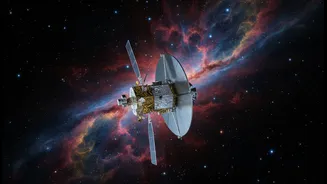



An Encore in the Kuiper Belt
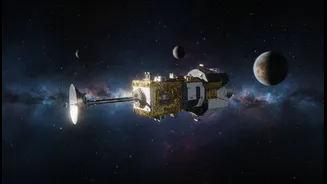
After reshaping our understanding of Pluto—revealing a world with vast nitrogen-ice glaciers, a layered atmosphere, and hints of a subsurface ocean—New Horizons sped onward. Its next major assignment was deep in the Kuiper Belt, a donut-shaped ring of icy
bodies beyond Neptune. On January 1, 2019, the probe performed another flawless flyby, this time of an object named Arrokoth. At a billion miles past Pluto, Arrokoth became the most distant and primitive object ever explored by a spacecraft. The encounter was a triumph. The snowman-shaped object, largely unchanged since the solar system’s formation 4.5 billion years ago, provided a decisive clue about how planets form, suggesting a gentle coming-together of material rather than violent collisions.
Waking Up in Deep Space
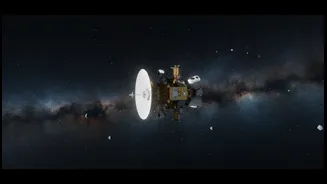
To conserve its limited power and resources during the long cruise through empty space, the mission team routinely places New Horizons into hibernation. On July 7, 2026, NASA announced the probe had successfully awoken from its longest hibernation yet—a 321-day slumber. Now over 9.5 billion kilometers from Earth, the spacecraft reported back in good health. It's so far away that its radio signals, travelling at the speed of light, take nearly nine hours to reach mission control. While most systems were powered down, several instruments continued to collect data around the clock, passively monitoring the strange environment of the outer solar system.
A New Mission: The Heliosphere
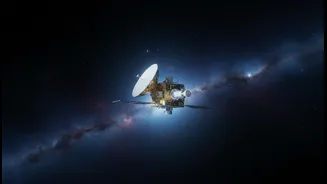
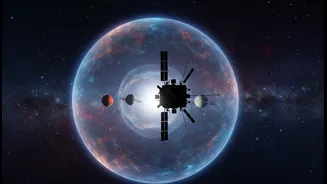
With its primary flyby missions complete, New Horizons has transformed into a deep-space observatory. Its current focus is studying the heliosphere—the vast bubble of charged particles, or solar wind, that the Sun blows around itself. The spacecraft is measuring how this solar wind slows down as it travels farther from the Sun and interacts with gas from interstellar space. These are the first-of-their-kind measurements from this unique region, providing invaluable data as the probe heads toward the boundary where the Sun's influence ends and interstellar space begins, a frontier known as the termination shock. This work builds on the legacy of the Voyager probes but with more advanced instruments.
A Race Against a Fading Power Source
The mission is a marathon, but not an infinite one. New Horizons is powered by a radioisotope thermoelectric generator (RTG), which uses the heat from decaying plutonium to generate electricity. This power source is incredibly reliable but its output naturally decreases over time. The spacecraft's systems have been updated with software designed to accommodate this declining power and the increasing communication delays. While engineers believe the spacecraft has enough fuel and power to continue operating into the 2040s, the day will eventually come when it can no longer phone home. Until then, every observation is precious.
The Search for One More Target
Even as it studies the heliosphere, the mission team holds out hope for one last close-up. Scientists are using powerful ground-based telescopes, like the Subaru Telescope, to scour the region ahead of New Horizons for another reachable Kuiper Belt Object (KBO). Finding a suitable target is a monumental challenge, as any potential object is incredibly faint and far away. NASA's mission extension, which funds operations until the probe leaves the Kuiper Belt around 2028 or 2029, keeps the door open for another flyby should a target be identified. Whether it finds another world to visit or not, the probe's journey continues to push the boundaries of exploration.