







A New Record, A New Era
In the world of solar technology, efficiency is everything. It’s the measure of how much sunlight hitting a panel can be converted into usable electricity. For years, the industry has seen steady, incremental gains, but a theoretical ceiling has always
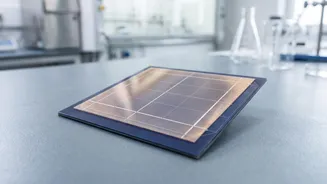
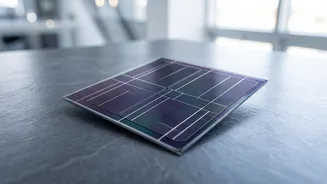
loomed. Recently, Chinese solar technology giant LONGi announced it had achieved a conversion efficiency of 30.1% on a commercial-grade M6 silicon-perovskite tandem solar cell. This achievement, independently certified by Germany's prestigious Fraunhofer Institute for Solar Energy (Fraunhofer ISE), isn't just another lab record; it marks the first time the 30% barrier has been broken on a full-sized, commercial wafer, a critical step toward mass production. This breakthrough is significant because it blows past the practical efficiency limits of conventional silicon-only cells and signals that the next generation of ultra-high-efficiency solar panels is within reach.
What Are Tandem Solar Cells?
Think of a standard solar cell as a single worker trying to catch balls of different sizes. It's good at catching one size (one part of the light spectrum) but misses others. A tandem solar cell is like a two-person team. It stacks a different, complementary material on top of the traditional silicon base. In this record-breaking case, the top layer is a material called perovskite. Perovskite is excellent at capturing high-energy light, like blue and green photons. The light that passes through—lower-energy red and infrared photons—is then captured by the silicon layer underneath. By working together, this “tandem” structure utilizes much more of the sun’s spectrum, dramatically boosting the total energy conversion. The theoretical efficiency limit for this combination is as high as 43%, far beyond the roughly 27-29% ceiling for conventional silicon cells.
Why Commercial Wafers Matter
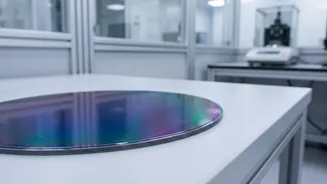
Achieving high efficiency on a tiny, square-centimetre cell in a controlled lab is one thing. Replicating that success on a commercial-sized wafer—the standard building block for solar panels—is a completely different and far more important challenge. This is where the LONGi milestone becomes so significant for the industry. It proves that the advanced layering techniques required for tandem cells can be applied at a scale relevant to manufacturing. According to LONGi’s R&D team, researchers overcame two key challenges in just six months: preparing large-area perovskite films in open air and developing a new low-temperature metallization process to create the electrical contacts. This demonstrates a viable path from laboratory prototype to factory production line, a journey that has often stalled promising new solar technologies in the past.
Hurdles on the Road to Your Rooftop
Despite the excitement, perovskite-silicon panels won't be appearing on homes tomorrow. Several hurdles remain for mass commercialization. The biggest challenge is durability. Perovskite materials can degrade when exposed to moisture and heat over long periods, and ensuring a 25- to 30-year lifespan, as is standard for today's panels, is a top priority for researchers. Another obstacle is cost. While perovskite materials themselves are inexpensive, the manufacturing processes are new and must be scaled up to compete with the highly optimized and massive production infrastructure that already exists for traditional silicon panels. Companies are now investing in pilot production lines to fine-tune these processes and prove the technology's bankability for large-scale solar farms and commercial projects.
The Impact for India's Solar Ambitions
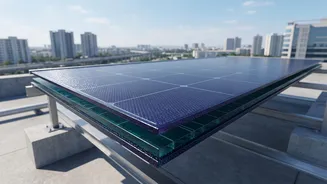
For a nation like India, with ambitious renewable energy targets, the arrival of higher-efficiency solar panels could be a game-changer. More efficient panels mean more power can be generated from the same amount of space. This is particularly crucial for a densely populated country where land for large-scale solar farms is a premium resource. It could make rooftop solar installations in crowded cities far more productive, allowing homes and businesses to generate a larger portion of their own power needs. Furthermore, as domestic manufacturing capabilities grow, adopting next-generation technologies like tandem cells could position India as a key player in the future of solar production, moving beyond assembling panels to innovating at the core technology level. The promise of generating significantly more clean energy from every available square meter of sunshine is a powerful incentive to watch this technology's development closely.