






Meet SPHEREx: A New Eye on the Sky
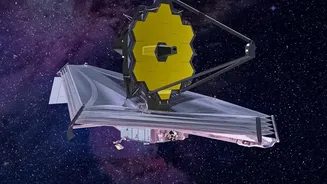
Launched in March 2025, NASA's SPHEREx observatory—short for Spectro-Photometer for the History of the Universe, Epoch of Reionization, and Ices Explorer—is on a two-year mission to create a comprehensive 3D map of the entire sky. Unlike telescopes that
focus on small patches, SPHEREx is a surveyor, scanning everything in its view multiple times. Its primary tool is spectroscopy, which breaks down light into its component wavelengths, much like a prism separates sunlight into a rainbow. By capturing the sky in 102 different 'colours' of infrared light, SPHEREx can determine the composition and distance of celestial objects, from distant galaxies to nearby stellar nurseries.
The Universe's 'Failed Stars'
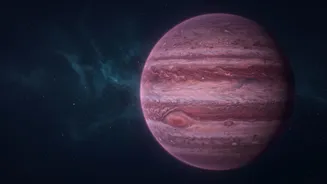
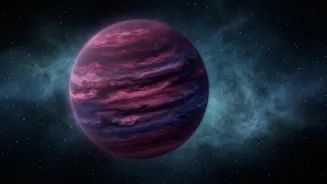
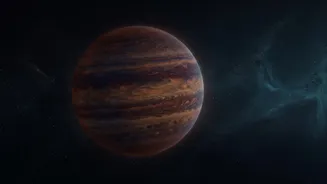
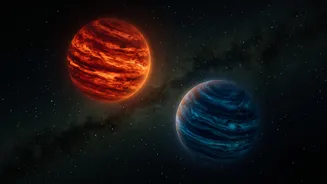
Brown dwarfs are often called 'failed stars', a label that captures their unique nature. They form from collapsing clouds of gas and dust, just like stars do, but they never accumulate enough mass to kickstart the sustained hydrogen fusion that makes stars shine. Generally, they fall in a mass range between 13 and 75 times that of Jupiter. While they aren't true stars, they aren't quite planets either. Many drift through space alone, not orbiting a host star, and they glow faintly with their own internal heat left over from their formation. This unique status makes them fascinating laboratories for understanding both stellar and planetary evolution.
Decoding a Faint, Faraway Glow
So how does SPHEREx study these dim wanderers? It analyses the infrared light they emit. As this light travels from the brown dwarf's interior out into space, it passes through its atmosphere. Molecules in that atmosphere, such as water, methane, and carbon dioxide, absorb light at very specific wavelengths. This process leaves a distinct pattern of dark lines in the object's spectrum—a sort of chemical fingerprint. By reading these fingerprints, scientists can identify the molecules present. Before SPHEREx, only a few dozen brown dwarfs had been studied in such detail. Now, astronomers are in the process of analysing thousands, building a massive catalogue to test their theories.
A Rich Menagerie of Worlds
Early findings from the SPHEREx mission, published in The Astrophysical Journal, have already revealed that these objects have chemically rich atmospheres, with clear signs of water, methane, carbon monoxide, and carbon dioxide. The data shows that no two brown dwarfs are exactly alike; even at similar temperatures, their chemical makeups can vary significantly. This diversity is a crucial clue. It suggests that factors beyond just temperature—perhaps age, formation history, or cloud dynamics—play a huge role in shaping what these worlds look like. The findings provide a treasure trove of real-world data to challenge and refine the theoretical models astronomers use to understand these objects.
Why Brown Dwarfs Matter
Studying brown dwarfs isn't just about cataloguing odd celestial bodies. Because they bridge the gap between giant planets like Jupiter and small stars, they provide a unique window into the processes of formation for both. The atmospheres of brown dwarfs can be seen as easier-to-study analogues of the atmospheres of giant exoplanets. Since brown dwarfs are often isolated, their light isn't drowned out by the glare of a nearby star, making them much easier to observe in detail. Understanding their atmospheric composition—including the presence of water and other key molecules—helps scientists piece together the puzzle of how the basic ingredients for life are distributed throughout the galaxy.