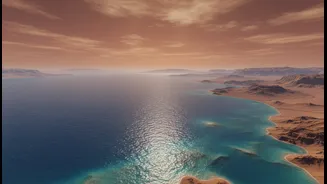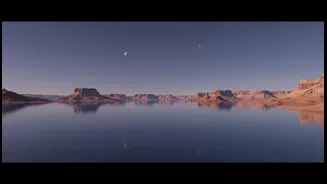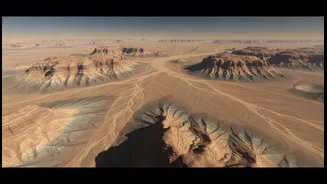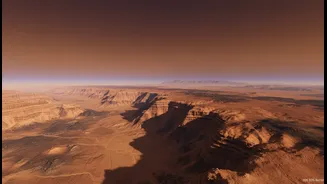






The Ghost of an Ocean
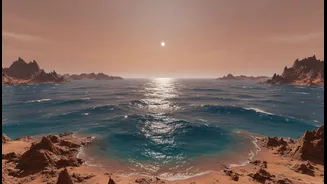
The idea of a Martian ocean is not new. Since the first orbital images in the 1970s, scientists have been intrigued by the stark difference between the planet's southern highlands and northern lowlands. The northern hemisphere is significantly lower in elevation,
leading to a long-standing hypothesis that it was once the basin for a massive body of water. Previous missions have found what look like ancient shorelines, river deltas, and minerals that only form in the presence of water, all hinting at a warmer, wetter past. However, the evidence has often been debated. For instance, these supposed shorelines were found at wildly different elevations, which puzzled scientists, as an ocean should have a consistent sea level.
A 'Bathtub Ring' on the Red Planet
The latest breakthrough comes from researchers who decided to look for a different, more stable geological feature. Instead of searching for faint, eroded coastlines, a team from Caltech and the University of Texas analyzed topographic data to find the Martian equivalent of a continental shelf. On Earth, a continental shelf is the edge of a continent that lies under the ocean, a relatively flat band that marks the true boundary between the continent and the deep ocean floor. Using computer models, the researchers simulated what Earth would look like if its oceans were drained, identifying the shelf as the most distinct and permanent 'bathtub ring' left behind. They then applied this model to Mars, and found a remarkably similar feature ringing the northern lowlands.
Connecting the Geological Dots
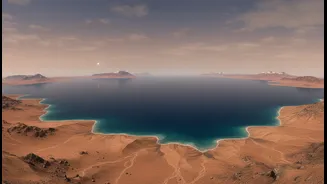
This discovery of a wide, flat shelf is considered a powerful piece of evidence because such a large-scale feature takes millions of years of stable conditions to form. It suggests the water wasn't just a series of temporary lakes or catastrophic floods, but a long-lasting ocean that may have covered up to a third of the planet's surface. This ancient ocean would have been vast, possibly as large as Earth's Arctic Ocean. The discovery helps tie together other observations, like ancient river deltas that appear to line up with the edge of this newly identified shelf. This consistency provides a more robust framework for the Martian ocean theory than the inconsistent shoreline data of the past.
The Search for Ancient Life
The confirmation of a stable, long-lived ocean on Mars has profound implications for the search for extraterrestrial life. Water is a key ingredient for life as we know it, and an ocean that existed for millions of years would have provided a potentially habitable environment. Just as on Earth, coastal sediments on Mars could have preserved a historical record of the environment and any life that may have existed. The sedimentary deposits along this ancient shelf are now prime targets for future robotic missions. Researchers believe that if Mars ever hosted life, these coastal areas would be one of the best places to look for its fossilized signatures. This discovery doesn't just reshape our understanding of Mars's past; it provides a treasure map for future exploration.
What Comes Next?
While this discovery provides strong support for the ocean theory, scientists emphasize that more work needs to be done. Follow-up analysis of satellite data is required, and the ultimate proof would come from a rover mission sent to examine the shelf deposits up close. Such a mission could analyze the rock layers, textures, and chemical composition to confirm they were formed by an ocean. The find has already made the region a high-priority target for future missions designed to hunt for biosignatures. Each new piece of evidence, from riverbeds spotted from orbit to the ground-penetrating radar data from rovers, helps paint a clearer picture of a planet that may have once been surprisingly similar to our own.